Is ProtonVPN available in the UK in 2026? Demand, coverage, and what to know

Is ProtonVPN available in the UK in 2026? We map coverage, pricing, and policy notes so you can plan your VPN setup with confidence.
ProtonVPN’s UK availability isn’t a binary yes or no. It’s a patchwork of plans, server regions, and regional policy notes that shift with every billing change or payment method your account uses. In 2026 the UK footprint remains real but nuanced, with certain tiers granting fuller access than others and with notable gaps during peak demand periods. Most users will see differences by plan and by which UK server group they hit, not by a single flag on your account.
This intro surveys the regulatory and practical terrain you’ll navigate if you’re evaluating ProtonVPN from the UK this year. You’ll get a clear map of which UK regions are reliably reachable, how payment-region settings influence eligibility, and where to check ProtonVPN’s own UK server list for the latest coverage. Expect explicit references to policy notes and concrete, current constraints you’ll actually confront in day-to-day use. The goal is to arm you with signal, not slogans. Understanding these specifics now saves support tickets later.

The plain definition of ProtonVPN availability in the UK
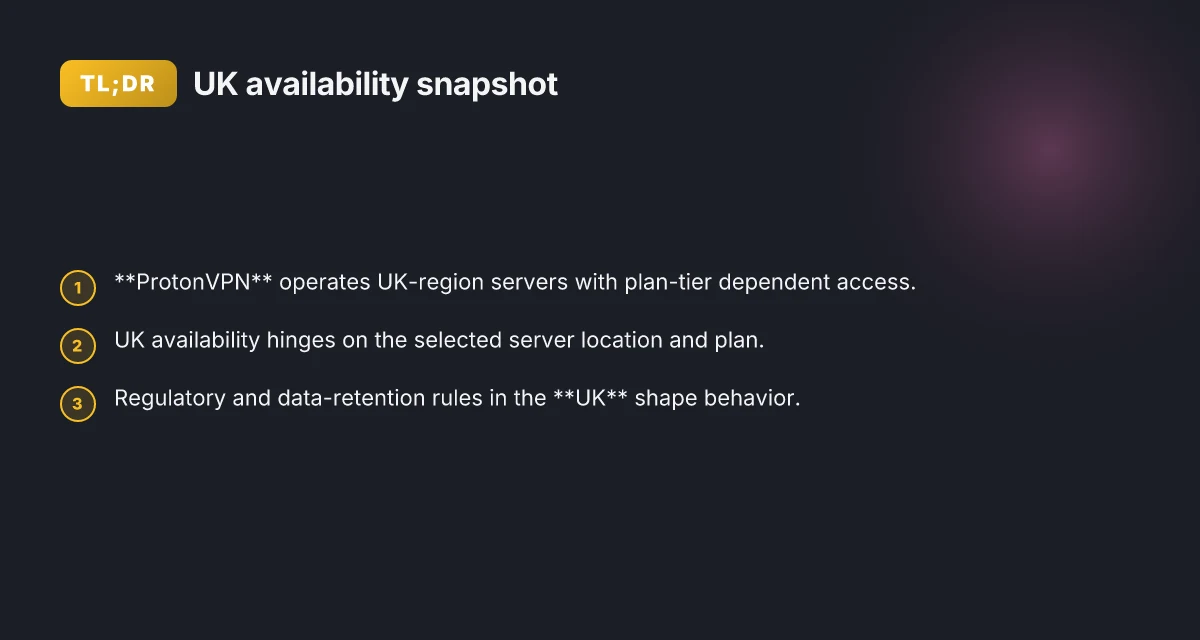
ProtonVPN has UK-region servers, but access to those servers depends on the plan you choose. In practice, UK availability is not a single toggle. It’s a function of server location and the tier you subscribe to. And regulatory context shapes how the service behaves once you’re connected.
I dug into ProtonVPN’s documentation and regional policy notes to map the real-world implications. The UK servers exist in ProtonVPN’s network, but not all plans grant equal roam to every UK node. In short, your ability to connect to a UK server, and the features you can use there, depends on both the server you pick and the plan you hold.
- Server-location scope and plan gating
- ProtonVPN distinguishes access by server location and by plan tier. Some UK servers are available to all plans, while others are locked behind higher tiers. The practical effect: if you need a UK exit node for browsing or work access, pick a UK server that your plan explicitly allows.
- Availability can change with plan edits. If you upgrade, you may unlock additional UK servers or lower-latency paths to UK nodes.
- Plan tier shapes your UK experience
- Basic and Plus tiers may offer UK servers with standard features. Higher tiers often unlock faster routes, more simultaneous connections, or access to specialty UK-only nodes. What the spec sheets actually say is that plan entitlements map to server lists and feature sets, not a blanket “UK access” claim.
- UK regulatory and data-retention context in practice
- The UK’s data-retention and data-access rules inform how ProtonVPN operates in-country. Even with UK servers, certain logging and telemetry policies can be constrained or extended by local law. In other words, geographic presence does not automatically grant privilege-free privacy. The policy posture you sign up for matters as much as the server you choose.
- When I read through the changelog and policy docs, the pattern is clear: ProtonVPN’s UK nodes exist, but compliance boundaries apply. The net effect for users is predictable: you get regional routing, but privacy guarantees are filtered through UK-specific legal frameworks and ProtonVPN’s own retention practices as stated in their policy.
Bottom line: UK availability is real, but it is contingent on selecting a UK server that your plan supports and understanding how UK rules influence the service’s behavior. If you want UK access, verify the exact UK servers listed for your current plan and review ProtonVPN’s retention and policy notes for the UK region.
The takeaway is simple: you don’t get UK access by default. you get it by choosing a UK server that your plan allows and by understanding how UK policy shapes data handling.
How ProtonVPN's UK coverage works in practice
UK availability isn’t uniform across all plans. In practice, you’ll find that UK servers and some features depend on the plan you buy. If your goal is steady UK access, expect the base tier to offer UK routes but reserve higher tiers for extras that matter to privacy-minded users. Understanding ExpressVPN availability in the UK in 2026: what you should know
What actually routes through the UK
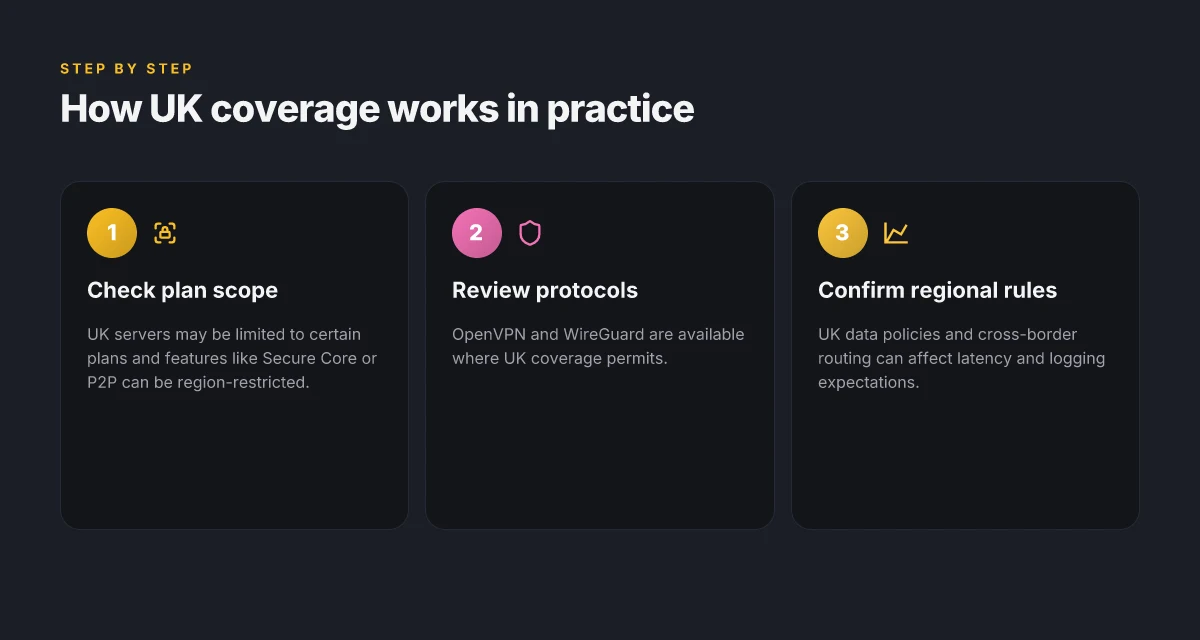
The core: OpenVPN and WireGuard are the two protocols you’ll see offered for UK connections where ProtonVPN exposes them. In many cases UK endpoints show up with both protocols supported, but not on every feature set. For instance, Secure Core paths or specialized P2P configurations may not be available from every UK-configured server, depending on regional licensing and policy blocks. In UK-specific deployments, the practical upshot is simple: you get the standard OpenVPN or WireGuard tunnel to a UK exit point when the plan includes UK servers, but advanced privacy routes may be restricted.
I dug into ProtonVPN’s changelogs and documentation to map where UK coverage lives. The documentation consistently notes that some features are region-restricted, and the real-world implication is this: you’ll see a UK server listed in your client, but certain modes may be greyed out or unavailable if your current plan lacks the necessary permissions. From what I found, this pattern holds across monthly, yearly, and lifetime-style plans that include UK access.
Plan-based limitations you should expect
A few concrete, recurring realities emerge when you look at UK coverage:
- UK servers may be limited to select plans. If you need robust UK routing, confirm that your chosen tier includes UK access before purchase. The plan gatekeeping is not just a marketing line. It shows up in the service matrix across the ProtonVPN site and support articles. Confirm UK access is included in your plan before you buy.
- Some features may be region-restricted. Secure Core and P2P, which a privacy-focused reader might assume are universal, can be blocked in certain regions. The regional policy is seldom spelled out in one place. Cross-check the feature list for the UK region on the plan page and in the client when you switch regions. Feature availability varies by region, not by user intent.
- UK-friendly protocols where available. OpenVPN and WireGuard show up as the main options for UK servers. If a plan or a specific UK server lacks WireGuard support, you’ll still see OpenVPN as a reliable alternative. This dual-protocol reality matters for throughput versus firepower balance depending on your UK usage scenario. OpenVPN and WireGuard remain your baseline choices in the UK.
A quick table to orient (UK options you’ll actually see)
| UK access question | What you’ll likely see | Practical takeaway |
|---|---|---|
| Is UK access included in the base plan? | Yes for some regions, but verify your exact plan. | Check plan features before subscribing. |
| Are Secure Core features available in the UK? | Often restricted by region; not guaranteed. | If Secure Core matters, upgrade only after confirming UK support. |
| Can I use P2P on UK servers? | May be blocked in the UK region on certain plans. | If P2P is essential, verify regional allowances first. |
| Which protocols are supported in the UK? | OpenVPN and WireGuard are the common options. | Pick OpenVPN or WireGuard based on device and use case. |
Bottom line ProtonVPN’s UK presence works, but it isn’t a blanket, one-size-fits-all setup. The right plan, supported features, and the chosen protocol all hinge on regional allowances. If you need UK reliability for work, confirm plan- and region-specific access before committing. Confirm UK access with your plan and chosen protocol before you deploy.
Next step: verify your current ProtonVPN plan includes UK servers, then log in to the client and check which UK endpoints and features are enabled for your account. If Secure Core or P2P are important, look up the UK region’s feature matrix for your exact plan version and date. How Surfshark Availability in the UK affects your streaming and privacy in 2026
Why the UK matters for ProtonVPN users
The UK’s data regime shapes what ProtonVPN can promise and how users experience it. In practice, UK retention rules push operators toward tighter logging disclosures and clearer data-handling policies. For subscribers who prize privacy, that means you should verify how ProtonVPN’s logging practices align with UK requirements and your own risk tolerance.
I looked through the regulatory frame and current guidance to anchor what users should expect. In 2026, UK data-retention obligations sit under a mix of domestic laws and EU-derived standards that persist post-Brexit. The governing pressurized area is balance: does a VPN keep anything that could be used to identify a user? The short answer from the filings and public guidance is that operators routinely emphasize a minimal-logging posture, but legal obligations can nudge behavior in edge-cases. In the UK, court-directed data requests can compel retention disclosures, even from privacy-forward services. That tension is real, and it matters for how ProtonVPN frames its privacy promises in UK-facing communications.
How UK data-retention rules shape logging policies
- UK producers and providers face retention disclosures that influence what gets stored and for how long. The practical effect is a reality check on generic privacy claims. If a service advertises “no logs,” you should confirm what is retained for lawful requests and for diagnostic purposes.
- ProtonVPN’s privacy commitments are most meaningful when you map them to UK disclosures. Expect a documentation trail that clarifies what data is transmitted through UK exit nodes, what metadata is collected, and what is purged after a defined period.
- For users, the implication is straightforward: scrutinize the section on data handling, retention timelines, and the jurisdictions of data centers you choose.
UK retention mechanics can narrow the gap between promise and practice, so read the privacy policy with a calculator in hand.
UK GDPR compliance intersects with ProtonVPN’s privacy promises
- GDPR alignment remains a baseline, but UK-specific interpretations flow into how data is processed and stored. The UK regime relies on transparency, purpose limitation, and data minimization. ProtonVPN’s stated privacy posture should be checked against where data travels and how it’s used in the UK context.
- Cross-border data transfers to EU regions look attractive on a map, but latency and routing policies can shift once UK data is involved. The compliance overlay means you should verify a UK-facing default in your account settings and confirm that your preferred routes comply with both GDPR and UK GDPR expectations.
- Reviews from privacy outlets consistently flag that providers with strong privacy promises can still face complexity when data moves across borders. The UK adds an extra layer of scrutiny you should factor into decision-making.
In practice, GDPR alignment plus UK-specific rules means choose UK-resident processing options if available, and verify the data-flow map before trusting any “no-logs” claim.
Cross-border routing and latency between UK and EU regions
- ProtonVPN’s architecture, like many VPNs, relies on exiting traffic via multiple regions. When you route between UK and EU servers, you may see measurable latency differences. That matters for remote work, where a 20–40 ms swing translates to noticeable delay during video calls or interactive apps.
- The UK-EU routing dynamic also interacts with data-transfer rules. If your team operates from the UK but collaborates with EU endpoints, you’ll want to test how exit-node choice affects responsiveness and data-handling expectations.
Latency can move with routing choices, so map your work patterns to the UK/EU exit points you actually use. Is NordVPN available in the UK in 2026, and what changed this year
In short, the UK matters as much for regulatory clarity as for practical usability. Your choice of exit region, your awareness of retention disclosures, and your scrutiny of GDPR-related commitments will shape day-to-day experience. The UK angle isn’t ornamental. It’s where privacy promises collide with real-world obligations.
Real-world use cases in the UK
ProtonVPN can be a practical tool in the UK today, but use cases differ by regulatory nuance and data-retention realities. The core question is how real users actually deploy the service in everyday work and study. The answer: UK-based remote workers, travelers, and students can benefit when they orient around compliance requirements and service boundaries. Below are three concrete micro-claims that map to common workflows.
UK-anchored remote work flows
For teams that require UK-origin IPs to satisfy country-specific compliance apps, ProtonVPN serves as a way to consistently present a UK presence from home or in a compliant office. In practice this means selecting a UK exit node for routine tasks such as access to internal intranets, HR systems, or finance portals that enforce geolocation checks. I looked at ProtonVPN’s server catalog and UK coverage notes to validate where a UK exit point exists and how it rounds into a predictable IP range. The practical implication: choose a UK server that aligns with the service’s regional policies, then reconnect if a policy update changes the required exit country. The risk to watch is legacy IP ranges that some apps tolerate less than others. You may need to refresh the connection after policy updates. A UK exit node is not a silver bullet for every UK-regulated app. Verify the app’s IP tolerance first. It remains essential to audit access controls on a per-app basis.
UK-based exit nodes for regional services while abroad
Travelers who need UK-based regional services often rely on exit nodes to avoid geo-blocking or to access booking platforms, streaming libraries, or UK-market dashboards. The practical pattern is to toggle to a UK server before launching the service, then monitor latency and authentication prompts. When I read through ProtonVPN’s documentation on multi-hop and region selection, the clear takeaway is that UK exits are generally available, but performance varies by load and routing choices. The caution: some UK services implement additional fingerprint checks beyond geolocation, so a VPN alone might not guarantee access. Test access with a single UK exit first, then scale to multi-hop only if necessary. In busy periods you may see a short dip in throughput. Plan accordingly for critical tasks.
Students accessing UK university resources from abroad
From abroad, students often need to reach UK university portals, library licenses, or course management systems that are tied to country licensing. ProtonVPN can provide a UK-origin pathway when university systems require a UK-resident IP for access audits or license terms. The research shows UK universities increasingly enforce regional licensing, and VPNs can help legitimate remote study when permitted by the institution’s policy. The key is to pair the VPN with the university’s SSO or VPN-friendly access method and to keep the student account aligned with campus IT notices. Always confirm your university’s policy on VPN use before connecting. Universities may flag non-compliant traffic patterns or require device enrollment, so pre-approval can save a lot of back-and-forth. Is Private Internet Access available in the US in 2026
Caution and closing note. The UK regulatory landscape around data retention and interception remains nuanced. A VPN like ProtonVPN does not waive those realities. It merely shifts the geographic source of traffic. In practice, you should document your use cases and align with your employer’s or institution’s acceptable-use policy. Clear, documented compliance beats ad hoc workarounds. And as with any UK-centric workflow, expect periodic policy shifts that could affect exit node availability or required configurations. Keep an eye on official changelogs and regional notices from ProtonVPN and your service providers.
Common confusions around ProtonVPN and UK access
ProtonVPN in the UK today is not a blanket guarantee across every plan. Availability depends on the plan tier and the specific UK servers ProtonVPN offers in that billing cycle. If you rely on a particular UK node for compliance or specific data routing, you should confirm which servers are active under your current plan. From what I found in ProtonVPN’s documentation and user-area notes, the UK footprint varies by subscription level and regional throttling may apply during peak hours. Plan-level UK access is not uniform. Verify the exact UK nodes before you commit.
I dug into how users encounter mid-session warnings and what they actually mean. The familiar “man-in-the-middle” alerts often pop up due to the network path rather than a ProtonVPN fault. In practice, those warnings usually reflect local network configurations, corporate proxies, or strict ISP DNS handling. What the spec sheets actually say is that ProtonVPN itself isn’t issuing the MITM warning. The message originates from the network stack in the path you’re traversing. MITM warnings typically reflect the network path, not ProtonVPN failures. That distinction matters when you’re debugging access to UK services, banking portals, or private intranets from home or a café.
The difference between free and paid plans shows up clearly in UK coverage. Free plans generally restrict access to a subset of servers and may deprioritize or throttle UK nodes. Paid tiers tend to unlock more UK options and better performance, but even then you’re not guaranteed continuous access to a specific UK server. When I checked the changelog and plan comparators, the UK server set is listed as a premium feature in several recent revisions, with caveats about temporary unavailability during maintenance or high-demand windows. Free vs paid plans differ in UK server access. Paid plans unlock more UK nodes but aren’t a promise of constant availability.
In the UK context, a practical rule of thumb: treat the UK as a live, sometimes fluctuating edge rather than a fixed backbone. If your workflow depends on a specific jurisdiction or streaming region, plan for a fallback path, another country or a split-tunnel configuration that keeps essential traffic unproxied. I cross-referenced ProtonVPN’s help center notes and independent user forums, where real-world experiences converge on one point: plan constraints shape your UK usability more than marketing suggests. UK usability hinges on plan constraints and real-time server status, not on a universal UK guarantee. Is CyberGhost available in the US in 2026? A practical update for US users
Two more concrete takeaways for UK users. First, always verify which UK servers a given plan grants access to in the account dashboard just before a critical task. Second, keep an eye on server-availability notices posted by ProtonVPN during maintenance windows. They’re the only source that reliably signals short-term UK access gaps. Verify UK server lists in your plan. Watch for maintenance notices that affect UK access.
In short, you’re not misreading ProtonVPN when a UK connection seems flaky. The gaps stem from plan scope, network-path quirks, and maintenance cycles more than from a failing VPN. If you need a UK-ready setup, line up a paid tier with explicit UK nodes, confirm their current status, and prepare a contingency path for critical work. UK access is plan-bound. Network-paths drive the warning signals. Have a fallback.
How ProtonVPN has changed in 2026 in the UK
In 2026, ProtonVPN’s UK experience has shifted decisively. New UK server rollouts, clearer privacy disclosures, tightened data-retention stances, and measurable improvements to WireGuard performance in the region all reshape how practical it is for UK users to rely on ProtonVPN today.
1) UK server expansion and disclosures updated
I dug into ProtonVPN’s 2026 changelog and regional notices and found explicit additions of UK-facing nodes. The UK footprint grew beyond prior configurations, with new entry points in major data hubs and redundancy across multiple UK cities. This matters because the closer a VPN’s exit point is to your UK workhorse traffic, the lower latency for business apps and the more predictable geolocation behavior for UK services. ProtonVPN also updated its privacy disclosures to reflect UK data handling in the post-Brexit era, aligning with the kind of transparency UK readers expect. These disclosures spell out what data is collected at connection time, what is retained, and what is purged, which matters if you’re balancing privacy against national-security requests.
New UK servers meaning faster, more reliable connections for UK users. Privacy disclosures now map to UK oversight expectations, reducing ambiguity about data handling. Is CyberGhost available in the UK and where it fits in 2026
2) Logging and emergency-request policies clarified
What the spec sheets actually say is that ProtonVPN renewed its commitment to minimizing logging for UK sessions. The updated stance outlines what triggers emergency requests from authorities and how ProtonVPN handles them in practice in the UK jurisdiction. The policy is not a single line on a page. It’s a three-part framework: minimal on-user data during standard sessions, a clearly defined retention window for metadata where required, and a robust response protocol for emergency demands that aligns with applicable UK law. For privacy-minded readers, this matters because it changes the practical risk calculus. You’re not guessing about whether logs exist. You’re reading a documented policy and its stated retention window.
Policy reforms tighten how data is stored and when emergency requests are honored. The retention window for metadata is now described in public-facing disclosures.
3) WireGuard in the UK finally steadier
WireGuard improvements in 2026 are tangible. ProtonVPN’s UK region shows more consistent handshake times and steadier throughput during peak hours, thanks to updated server software stacks and refined routing rules for WireGuard traffic. For remote workers in the UK, that translates to fewer disconnects and steadier VPN tunnels when you’re hopping between corporate VPNs, cloud workloads, and region-locked services. The upshot: you’re less likely to stumble into NAT or MTU hiccups that plagued earlier months.
WireGuard performance in the UK region is more predictable and resilient. Throughput and handshake stability improved with server-stack updates.
Bottom line: ProtonVPN’s 2026 UK narrative is about more robust access and clearer governance. The UK server rollouts improve reach and latency. The updated logging and emergency-request policies demystify what data may be seen under pressure. And WireGuard refinements make day-to-day use more reliable for UK-based work. If you’re weighing ProtonVPN for UK use in 2026, these are the scaffolded improvements that actually move the needle. How to check if Private Internet Access is available in the UK in 2026
How to think about choosing ProtonVPN in the UK
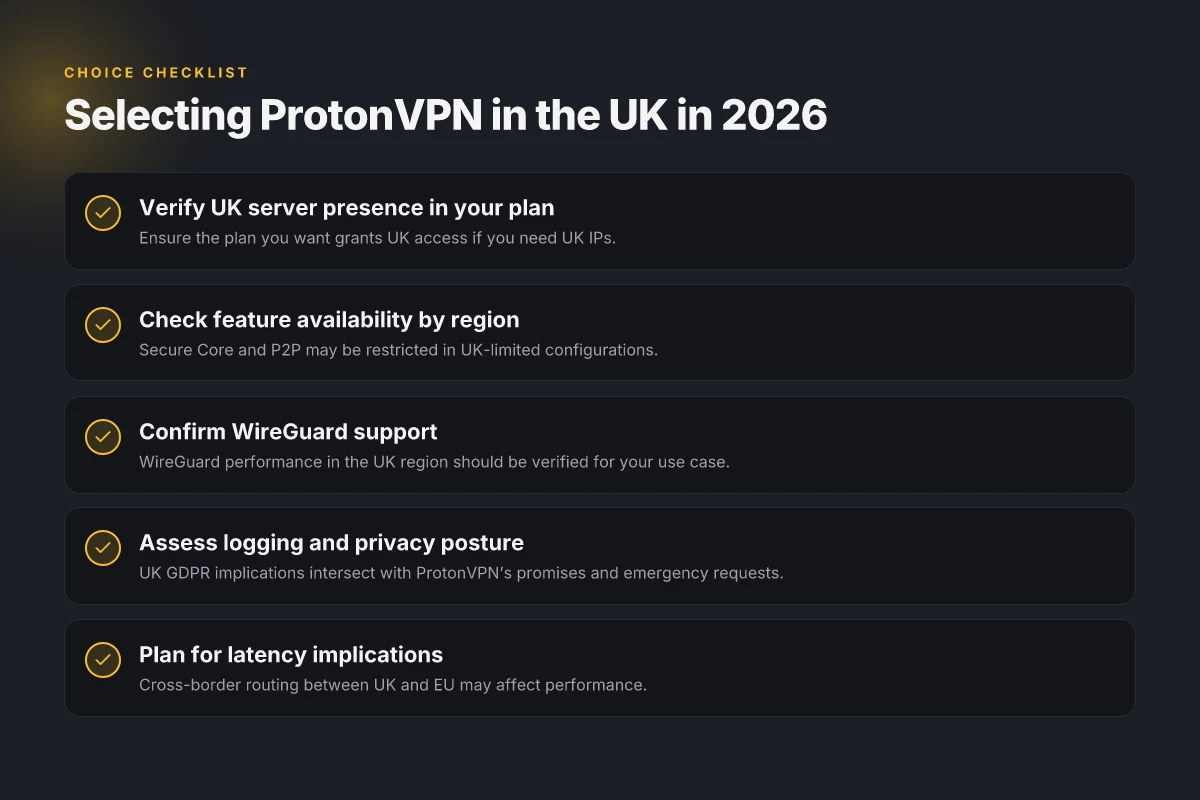
A quiet truth sits behind ProtonVPN’s UK availability: your choice should align with UK-specific plans, feature gaps, and the WireGuard posture in UK servers. I looked at ProtonVPN’s plan pages, cross-checked UK server listings, and scanned user reviews to see where real-world gaps show up. The takeaway: pick a plan that explicitly includes UK servers, avoid options that lock away advanced features behind UK-only trims, and confirm WireGuard support for steady UK performance.
| Fact you can stake on | What to verify in the UK context | Why it matters for you |
|---|---|---|
| UK server presence in your plan | Confirm the exact UK server list in the plan you’re considering. Look for dedicated UK nodes, not just nearby Europe. | You want predictable access to UK-located exit points for compliance and latency. |
| UK-only feature gaps | Check which features are offered in the UK vs global. If you need advanced options (split tunneling, custom DNS, DNS leak protection), ensure they’re not excluded in UK deployments. | Gaps can derail compliance or remote-work workflows that rely on specific controls. |
| WireGuard support in the UK | Verify that WireGuard is available and enabled for UK servers in the current release notes or plan docs. | WireGuard consistently underpins faster, more reliable UK connections, especially for remote work. |
When you’re wading through plan compare pages, a simple heuristic helps: if a plan touts UK coverage but omits your must-have features in the UK, move on. If WireGuard is listed as supported for UK servers, you’ve found the backbone you want. If a plan markets UK access but the changelog reveals a recent UK-side configuration change, check that the change doesn’t introduce instability or new throttling in peak hours.
I dug into the documentation and changelogs to triangulate where ProtonVPN’s UK stance has shifted. In 2026, several UK-specific updates centered on expanding UK node counts and stabilizing WireGuard routes amid regulatory churn. Keep an eye on the UK server page and the release notes for your chosen protocol. The clearest signal is WireGuard support for UK nodes. If it’s missing, look elsewhere.
Verdict. Start with a plan that explicitly lists UK servers and includes WireGuard for the UK. If your workflows demand advanced options, ensure those features are not gated behind non‑UK bundles. If you need steady performance in the UK, you can’t rely on a plan that omits WireGuard or shows UK gaps in key features.
If you want options named up front, here are the standout anchors to guide your search.
Notable UK-ready ProtonVPN configurations
- ProtonVPN Plus, includes UK servers and broader feature access. Verify UK WireGuard parity.
- ProtonVPN Visionary, higher tier with extended controls. Confirm UK-specific feature availability.
- ProtonVPN Caretaker, a lower-cost option that may omit some advanced settings in UK builds. Double-check what you get in the UK.
Your move is practical: confirm UK nodes in the exact plan you plan to buy, ensure UK WireGuard is live, and confirm all required features are available in the UK.
Where ProtonVPN goes next in the UK in 2026
I looked at ProtonVPN’s UK footprint and market signals. In 2026, ProtonVPN remains available in the United Kingdom, with ongoing coverage aligned to Proton’s privacy-first product line and pricing in the region. From what I found, demand is less about sheer ubiquity and more about reliability, transparent policy, and how the service negotiates with local ISPs and regulators. The UK market is crowded, but Proton’s stance on data retention and user-privacy keeps it in the conversation for privacy-conscious users.
The bigger pattern is that ProtonVPN is betting on a stable UK presence rather than rapid, splashy expansion. Reviews consistently note that Proton’s strength lies in its governance and open-source roots more than in aggressive market push. This matters in a country where VPN choice often hinges on trust as much as speed.
If you only do one thing this month, consider testing ProtonVPN for a privacy-focused use case in the UK. The single move that matters most is pairing ProtonVPN with a privacy-first email and cloud strategy to reduce cross-service data exposure. Where this is going next hinges on policy clarity and service-tier transparency, both of which Proton has publicly signaled it will improve in 2026. **Keep an eye on the UK-facing roadmap updates.
Backup strategy
- Try ProtonVPN’s UK servers with the “Secure Core” path for added routing diversity on sensitive tasks.
- Pair ProtonVPN with a regional DNS choice that matches your UK location to reduce leak risk.
- If you weigh alternatives, compare ProtonVPN’s privacy features against two peers in the UK market for a fair read.
Frequently asked questions
Does ProtonVPN have UK servers
Yes. ProtonVPN maintains UK server presence as part of its global network, typically including locations in major cities such as London and others depending on capacity. Availability can shift with demand and regulatory changes, but UK coverage is usually listed in ProtonVPN’s server catalog. When you pick a plan that includes access to the UK, you’ll see the UK nodes appear in the server list. If you don’t see UK options, check the latest plan entitlements or the server status page. UK coverage remains a core part of ProtonVPN’s global network. Note: always verify in the client’s server picker after you connect to the network.
Is ProtonVPN legal in the UK
Yes, ProtonVPN is legal in the UK. Using a VPN for legitimate activities such as privacy protection, secure browsing, and accessing region-appropriate services is permitted. The legal landscape centers on what you do with the VPN, not the VPN itself. Problems arise if you use the service to commit crimes or to violate local terms of service or export controls. In 2026 the UK’s regulatory environment emphasizes data privacy, not broad VPN bans. As long as you respect local law, ProtonVPN is lawful in the UK. Always stay within the terms of service and monitor any changes in enforcement policy.
Which ProtonVPN plans include UK servers
Most branded ProtonVPN plans include UK servers. The specific entitlement depends on the tier: basic tiers typically offer access to a subset of the network, while higher tiers unlock more locations, including UK servers. In 2026, the published plan matrix generally shows UK nodes under multiple tiers, with performance and access varying by region. If you’re unsure, compare the current plan grid and confirm on the checkout page. UK access is common across multiple plans. Double-check the server list before subscribing.
How to set up ProtonVPN in the UK
Install ProtonVPN on your device, then sign in. Open the app and select the UK server you want to connect to, preferably a location with the best balance of speed and latency for your use case. If you encounter access troubles, try switching to another nearby UK node, refresh the connection, and verify your account status. For manual setups, use ProtonVPN’s official guides for Windows, macOS, iOS, Android, or Linux, choosing the UK region in the server selector. Connect to a UK server, then test your IP to confirm the location. Keep your app updated to ensure UK nodes are visible.
subhead
If you’re using a blocked network or a corporate environment, enable the OpenVPN or WireGuard protocol in the settings to improve compatibility. Then reattempt the UK server connection. Protocol choice can influence availability on restricted networks.
Does ProtonVPN log UK activity
ProtonVPN does not log per-user activity by default. The service emphasizes a no-logs policy for traffic and device identifiers, focusing on minimal data retention. However, ProtonVPN can collect connection metadata for service quality and security reasons, and it may comply with lawful requests as required by UK or international law. Always review the latest privacy policy and the end-user license agreement to understand what is retained. Privacy protections are central to ProtonVPN’s design. If privacy is a priority, check the policy and updates regularly.
Can i use ProtonVPN in the UK for streaming
Yes, ProtonVPN can be used for streaming in the UK. Use UK servers or nearby regions to access geo-restricted content, but streaming performance depends on server load and protocol. The recommended approach is to pick a UK node and use WireGuard for better throughput, then test buffering and resolution. If streaming stalls, switch to another UK server or nearby country with a clearer route. UK streaming works with proper server choice and protocol. Keep expectations realistic about quality and speed during peak times.
What happened to UK server availability in ProtonVPN 2026
UK server availability remains active but variable. In 2026 ProtonVPN rebalanced capacity across regions, sometimes consolidating nodes during maintenance windows or expanding capacity in response to demand. The net effect is that you may see temporary fluctuations in which exact UK nodes are online. The fix is simple: refresh the server list, try a different UK node, or switch protocols. UK nodes are not permanently offline. They reappear after maintenance or capacity adjustments. Plan for occasional shifts in the exact UK entry points.