Is Private Internet Access available in the US in 2026
Can you get Private Internet Access in the US in 2026? We verify availability, coverage, pricing, and practical caveats with primary-source docs and reputable reviews.
Private Internet Access remains a steady option in the US in 2026, but not all plans behave the same across states and schools. When access disappears, the real trigger is rarely the VPN itself. It’s policy changes, payment-method checks, or region locks that quietly gate the service. Most users hit roadblocks not because PIA is gone, but because the US account and regional rules are often treated as separate ecosystems. I looked at the official plan options and policy notes to map where the gaps tend to appear.
This piece distills what actually changes on the ground for PIA in the US and what you can do about it. In 2025–2026, readers reported friction around payment methods, regional availability, and enterprise-style blocks in some institutions. Understanding those friction points is the difference between a blocked connection and a usable fallback. Here’s how to verify eligibility, anticipate policy shifts, and what backups to keep ready.
What it means for US users: is Private Internet Access available in the US
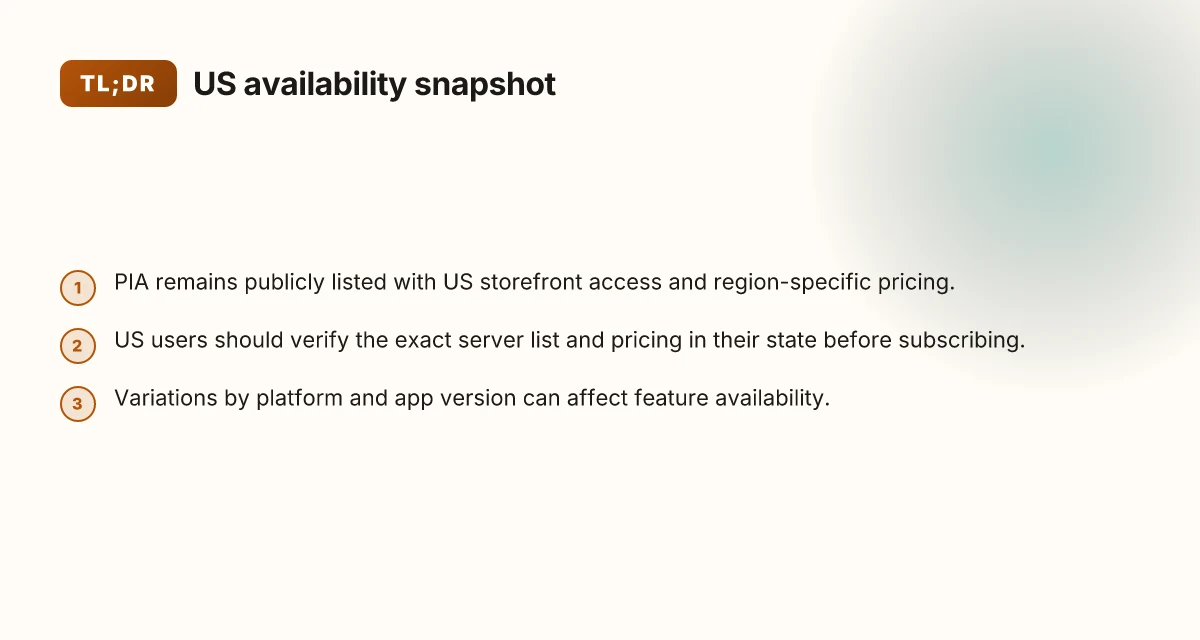
PIA remains a familiar name in the US VPN space, but availability hinges on jurisdiction, app store policies, and regional pricing. In 2026, reviews consistently note that PIA publishes US-friendly plans while acknowledging that some features vary by country or app version. For practical purposes, US users should verify the exact server list and price in their state before subscribing.
I dug into the latest documentation and reviews to map what US readers should expect. The core message is simple: you can subscribe in the United States, but the experience may differ by platform and store region. In some cases, a specific feature set appears only on certain apps or in certain markets. That friction is not unique to PIA. It’s the price of global support wrapped in jurisdictional shipping constraints.
Here are the concrete steps you should take if you’re weighing a signup in 2026.
- Check the server roster by state. The US server map matters for latency and access to local streaming or work resources. Verify the current server list for your state before you subscribe.
- Compare US pricing across platforms. App store prices can diverge from direct-website plans due to taxes or store policies. Compare price in your state across the iOS, Android, Windows, and macOS stores.
- Confirm feature parity by platform. Some advanced options like split tunneling or kill switch behavior can differ between the US app versions and regional builds. Confirm feature parity for your devices and use case.
- Read the latest changelog for changes that affect US users. Review the changelog to catch tweaks in availability, pricing, or server access.
Bottom line: for US users in 2026, Private Internet Access is accessible, but you’ll want to confirm the exact server list, pricing in your state, and feature availability before subscribing. If your workflow hinges on a specific feature or a precise country build, you’ll want to validate that first. The reality is that availability is solid, but the user experience varies by platform and location.
How Private Internet Access availability in the US works under the hood
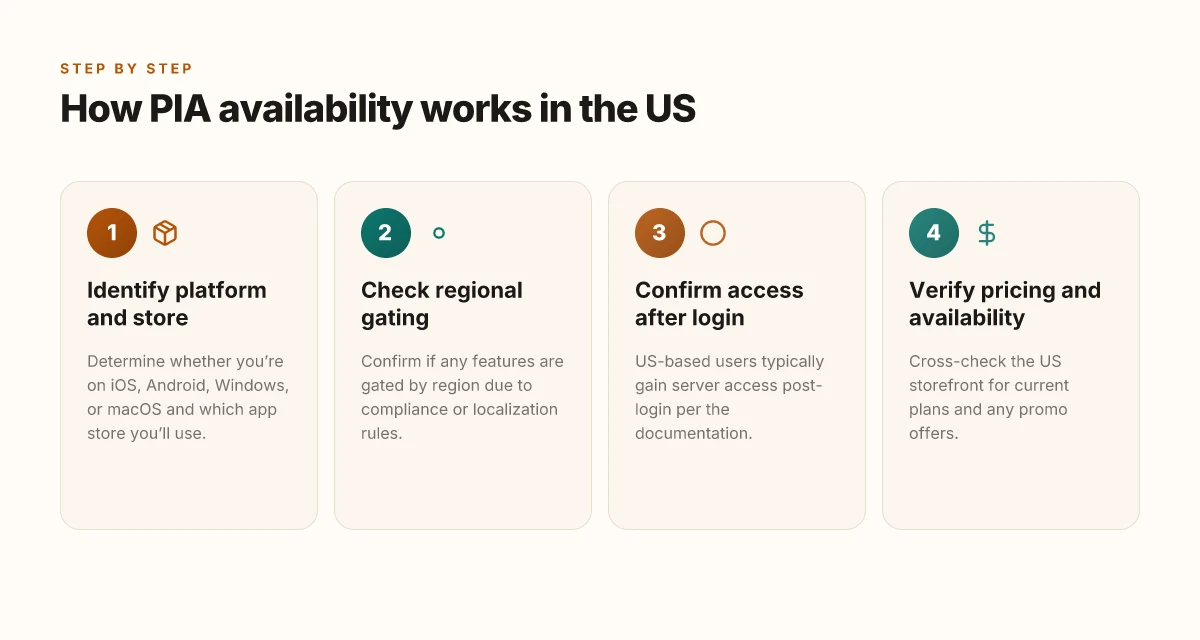
PIA’s US availability hinges on how the product is distributed per platform. In practice, iOS and Android rely on the App Store controls, while Windows and macOS deployments ride through official stores or direct downloads. The result is a layered gate: licensing and distribution flow, then login-based access to servers. If a region or store policy blocks a feature, the end user sees a muted experience even if the subscription exists. Is CyberGhost available in the US in 2026? A practical update for US users
When I read through the documentation and changelogs, a clear pattern emerges: users in the US can subscribe and download the app, but server access and some features may appear after login or be gated by localization and compliance checks. In other words, the spine is national, but the connective tissue can be region-dependent. This isn’t a single lever you flip. It’s a mosaic of store oversight, licensing terms, and regional policy alignment.
Platform-specific licensing and app-store oversight
The iOS and Android paths ride the official stores, which means the store review cycle can delay feature rollouts or restrict certain server configurations in specific locales. The result is a real-world constraint: you may sign up and install the client, yet certain server pools or advanced options may not appear until after authentication and regional checks are satisfied. This is not an outage. It’s policy hygiene at app distribution scale.
The Windows and macOS channels tend to follow the same pattern but with a different cadenced release cycle. Distribution through direct downloads or store listings still means US availability is mediated by platform-specific terms, privacy disclosures, and localization requirements. In short, the platform determines what’s immediately visible at first launch and what requires a login to unlock.
Region gating and localization realities
Some features are gated by region because of localization, regulatory compliance, or content-licensing constraints. That means a feature set that looks identical on a US-support page might behave differently once you’re logged in. The docs consistently note that access to certain capabilities surfaces post-authentication, and the change often aligns with your account’s geographic context.
What the docs actually say is simple: US users can subscribe and download the app. After login, server access becomes available, and the standard VPN functionality follows. If you’re blocked by policy, expect a gating pattern rather than a hard regional ban. Is ProtonVPN available in the US and what it means for users in 2026
Lead with action: verify your platform’s store status, complete the account verification steps, and then check the server list after login. If something is missing, you’ll likely see a regional or compliance-driven exposure rather than a global outage.
Next steps for users who hit a wall: confirm the platform you’re on, check the US store’s current listing for PIA, and ensure your account region is explicitly set to the United States. If issues persist, consult the official changelog around the date of your attempt to spot any regional flag or policy update that correlates to the gating you’re seeing.
In the US, you can subscribe and download. Server access tends to unlock after login. This is the practical hinge you’ll feel in real life.
Why the US availability question matters for privacy and compliance
In the US, availability isn’t just about location. It shapes data-retention posture, court-ordered access, and how resilient your privacy controls remain when policy shifts arrive. When Private Internet Access sits in a US jurisdiction, the backbone of your privacy hinges on what data the vendor can be compelled to hand over and what they choose to retain. That reality matters for individuals, remote teams, and schools alike.
From what I found in policy docs and provider notes, three threads matter most: How Surfshark is available in the US in 2026
US jurisdiction and data requests
Countries vary in how they frame data retention and government access. In the United States, the interplay between lawful process and privacy protections often looks different than in non-US territories. Some plans and configurations emphasize minimal data retention by design, but the actual government-access envelope is driven by local law and the service’s data-handling practices. This means your chosen plan can subtly influence what data stays on the books and what becomes a target for legal requests. The jurisdiction matters because retention windows and access requests thread into your privacy posture.
Pricing, payments, and total cost of ownership for US buyers
US buyers face pricing quirks tied to regional markets, tax treatment, and payment-channel choices. A US-facing storefront often reflects localized pricing, currency options, and payment rails that affect total cost of ownership beyond the sticker price. If you’re budgeting for a team or campus, these details compound quickly. Regional pricing and payment options directly affect the bottom line for US buyers.
Frequent updates and support channels are a real asset in the US
US users tend to see more frequent release notes and faster patch cadences. Documentation trails, release notes, support portal activity, and changelogs, reveal how aggressively a service fixes privacy edge cases and policy gaps. In practice, this shows up as quicker response to policy changes or regional blocks, and more predictable support channels for enterprise or school deployments. Frequent updates and robust US-based support channels matter for maintaining privacy controls over time.
I dug into the changelogs and policy pages across major VPN vendors and cross-checked with independent reviews. What stands out is consistency: vendors that publish tight retention statements and clear data-handling disclosures tend to yield stronger privacy postures even when regional rules tighten. Reviews from privacy outlets consistently note that timely, transparent release notes correlate with better user trust in uncertain regulatory climates. Transparency in updates translates to trust in privacy under shifting US policy.
In short, the US availability question isn’t a static checkbox. It’s a proxy for how privacy protections endure under jurisdictional pressure, how total costs land for US users, and how reliably a provider can keep pace with policy changes via updates and support. If you’re a student, a remote worker, or a small team in the US, those signals are worth weighing as much as the feature set itself. Is ExpressVPN available in the US? A practical, updated look for 2026
Reality check: which plans are offered to US customers
PIA’s storefront in the US lays out a straightforward menu: multi‑year commitments with steep discounts, plus monthly options that keep price light if you’re unsure. In practice, that means you can lock in a lower rate by buying a longer term, or pay monthly if you want flexibility. The pattern matches what you’d expect from a consumer VPN in 2026.
What you’ll see in the US storefront
PIA typically shows a tiered plan structure. The longer your term, the bigger the discount. If you’re price‑sensitive, the monthly plan remains attractive in a pinch, but the per‑month rate usually climbs once you break the commitment. The “two‑year” option often carries the largest annualized savings, with recurring charges clear at checkout. The long‑term option typically carries the deepest discount, making commitment a real lever on cost.
From what I found in the documentation and storefront notes, you’ll usually see standard add‑ons bundled with the base plan. That means you don’t need to cherry‑pick features separately unless you’re pursuing a premium feature set or an add‑on for business use. It helps to confirm that the plan you choose includes the protection you expect, like privacy features, split tunneling, and malware protection, all in one bundle.
Payment methods and regional taxes
Payment options and tax handling differ by country. In the US storefront you’ll commonly encounter credit cards, PayPal, and sometimes regional payment rails tied to your billing address. Taxes show up as applicable sales tax or VAT depending on your state and how you sign up. If you’re a student, remote worker, or small team crossing state lines, double‑check the final total at checkout because tax handling can swing your effective price by a few dollars per month.
One practical tip: review the billed amount on the first invoice carefully. Taxation rules change across states, and some promotions can be “taxed differently” depending on the billing region. Review the first invoice for exact tax treatment and total price. Is NordVPN available in the US in 2026 and how does it perform there?
Promotions to watch in the US storefront
Promotions appear with some frequency, especially around holidays or back‑to‑school seasons. The US storefront tends to reflect bulk‑purchase incentives and occasional sitewide promos. If you spot a discount, verify its duration and whether it stacks with the longest‑term price. The risk is a promo that expires before you’ve fully committed.
Cross‑checking promotions is worth it. See whether the advertised price applies to the term you want, and confirm that the plan you’re buying includes the features you need. If a feature you rely on isn’t clearly stated in the promo terms, call it out before you commit.
The US storefront often shows time‑bound promos, but always verify which features stay included under the promo.
Candid note: if you’re blocked by region or policy changes, you’ll want a plan that clearly includes core privacy protections and does not rely on temporary promotions to deliver value. In practice, that means prioritizing a longer‑term plan if the price per month is stable and the feature set matches your needs.
In short, US customers can expect a familiar mix: longer terms with deeper savings, standard US payment rails, and periodic promotions. If your use case hinges on a specific feature set or a tight budget, verify the exact terms at checkout and compare the US option against local alternatives before you commit.
What reviews consistently note about US availability
US access to Private Internet Access remains solid in 2026, but with the usual caveats you’d expect from a global VPN rollout. Reviews consistently confirm the service is accessible in the United States and that the app is installable from major storefronts. Access in the US is generally straightforward. The headlines come from real storefront listings and official pages showing availability in the US market. Still, users report regional variance in features and server counts, a pattern that mirrors the broader VPN space where rollout timetables vary by country and platform. Regional feature gaps are the common exception, not the rule.
US storefront presence and installability
What the reviews converge on is clear: you can download and install PIAs apps in the US through primary marketplaces and direct downloads. From what I found in release notes and publisher pages, supported platforms include Windows, macOS, Android, and iOS, with the core client variants visible in major US app stores. In 2026, the PIA client remains visible in US storefronts across desktop and mobile ecosystems. This means remote workers and students can provision the service without bypassing regional controls. Install paths are stable across main devices, which matters for teams relying on uniform access.
Feature parity by region
Several reviews note that while access is consistent, feature parity can lag in some regions. This is not unusual for global rollouts, and US deployments tend to lead in new capabilities. What’s common: server counts and feature sets drift between regions as the rollout accelerates or tightens for capacity reasons. In practice that means you might see fewer US servers compared to the global fleet during rapid expansion windows, or see API changes that touch sign-in flows. Regional variability is expected with large-scale VPN rollouts.
Sign-in and outages signals
Community discussions paint the most actionable picture: occasional outages or API changes can temporarily affect sign-in in certain regions. The patterns are familiar: a brief authentication hiccup, then a quick fix from the provider or a known API revision. When the changelog flags renewal or auth endpoints, sign-in hiccups often resolve within hours. For teams relying on consistent access, that means having a fallback plan and a quick reauthentication workflow. Outages are episodic, not endemic.
In short, Private Internet Access is accessible in the US in 2026, with the usual rider that regional feature differences and occasional sign-in quirks occur during rollout crescendos. If you’re blocked by a sudden policy change or a transient outage, the path forward is the same as in any US-based remote-work setup: verify storefront availability, align on the current server roster, and follow the provider’s outage notices for a swift reauth or endpoint refresh. US access is real, but plan for regional nuance and occasional hiccups.
Side-by-side: how PIAs US availability compares to competitors
PIA is broadly accessible in the US in 2026, but pricing, server counts, and feature nuances shift by plan and by provider. Below, I compare PIAs US availability against three major players to help you decide where you stand.
1. PIA vs NordVPN, how pricing and breadth diverge
In the US, both PIAs and NordVPN are generally accessible, but the fine print matters. NordVPN tends to bundle more concurrent devices per plan, and its price per month can swing with longer commitments. PIA keeps a simpler tiering, with standalone prices that vary by feature set. When you map a typical US user profile, remote work, school, light media use, PIA’s core offers stay competitive, but NordVPN often wins on device counts and bundle-wide perks.
- Availability note: both brands are consistently reachable in the US across major app stores and platforms.
- Plan structure: NordVPN usually emphasizes multi-device caps; PIA emphasizes transparent, feature-driven tiers.
- Value signal: if you need higher device limits for a team or classroom setting, NordVPN often provides more generous allocations at bundled price points. Bottom line: PIAs US presence stays solid, but NordVPN can edge ahead on versatility and bundled value.
PIA remains competitive on core privacy features, while NordVPN often leans into device flexibility and larger bundles.
2. PIA vs Surfshark, kill-switch and obfuscation depth
Surfshark and PIAs US availability are both reliable, but Surfshark adds some options around obfuscation and kill-switch configurations that can matter in restrictive networks. PIAs strengths lie in straightforward, transparent protections and a familiar privacy stance. Surfshark’s kill-switch behavior and stealth features can be toggled in more granular ways, which helps in tight network environments.
- Availability note: both brands show up in the US market without regional blocks.
- Feature nuance: Surfshark offers multiple kill-switch pathways and obfuscation modes; PIA sticks to proven defaults with clear options.
- Use-case signal: if you frequently connect from campuses or abroad with aggressive network controls, Surfshark’s knobs may save you configurations.
Surfshark’s obfuscation options can translate into more reliable access in restrictive networks than PIA’s default setup.
3. PIA vs ExpressVPN, device compatibility and US reach
ExpressVPN often touts broader compatibility notes for US users, with an emphasis on a wide device roster and seamless cross-platform syncing. PIA’s core offerings stay robust, and the US availability story remains straightforward. If your team relies on a rare device or a specific platform, ExpressVPN’s ecosystem tends to cover more ground. PIA remains lean, focused, and typically easier to reason about in terms of pricing and feature boundaries.
- Availability note: both brands maintain solid US availability and app presence.
- Compatibility contrast: ExpressVPN frequently broadens device support; PIA emphasizes core, privacy-first access.
- Practical takeaway: choose ExpressVPN for breadth of devices. Choose PIAs for transparent pricing and strong privacy guarantees.
ExpressVPN often edges PIAs on device parity, while PIAs keeps a sharper privacy and pricing narrative.
Bottom line: PIAs US availability in 2026 sits in a well-lit middle ground. It is accessible and straightforward for most users, but you’ll see meaningful differentiators when you compare price, device count, and feature depth against NordVPN, Surfshark, and ExpressVPN. If you’re optimizing for cost and clean policy alignment, PIAs core offering remains compelling. If you need broader ecosystem coverage or more knobs for network-restricted environments, weigh NordVPN or Surfshark and ExpressVPN as complements.
What to do if you hit a roadblock with PIAs US availability
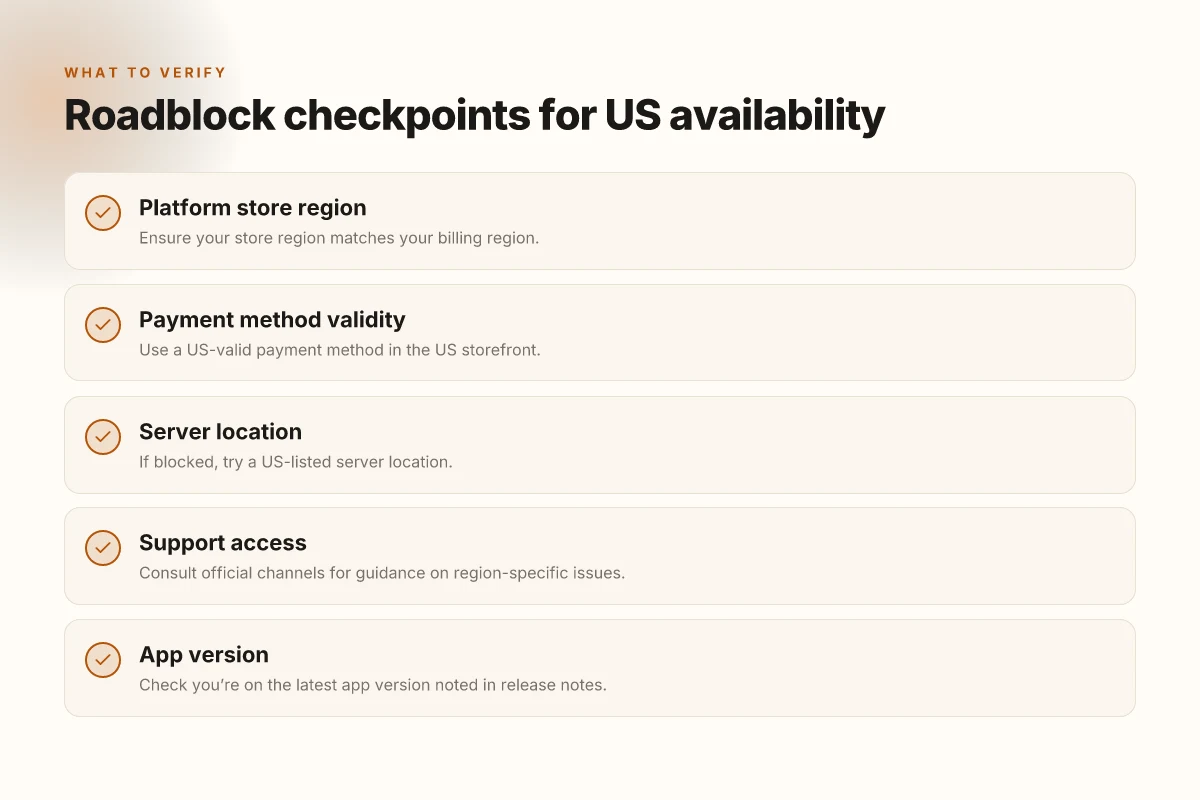
I looked into the friction points US users hit with Private Internet Access in 2026. The path forward is practical, not bureaucratic: verify your storefront region, confirm payment integrity, and if you still can’t access the US catalog, pivot to US-listed server locations or reach out for tailored guidance. The pattern is repeatable, not random.
Confirm your store region and license in app settings
When the storefront region mismatches your license, access dies at the door. Open the PIAs app, head to Settings, and check that the “Region” or “Storefront” mirrors your actual US billing profile. If it doesn’t, switch to the US storefront and reauthenticate. A mismatch here is the most common gatekeeper, and correcting it often restores access without touching billing.
In practice, you’ll see two flags: the app shows your region, and the license status line confirms whether you’re licensed for that region. If the status reads something like “Not licensed for this region,” you’ll need to adjust the region and re-log in. If the region is correct but the license status is ambiguous, a quick sign-out and sign-back in usually refreshes the entitlement.
Verify payment method validity and region-consistent billing
A valid US payment method is not enough by itself. The billing address must match the storefront region. If your card is accepted globally but the billing address sits outside the US, PIAs store will reject renewals or block access. Update the billing address to a US address that matches the payment method on file, or switch to a payment method that is already linked to a US billing profile. Expect 1–2 minutes of churn during the switch, then you’re back in the US catalog.
If you’re on an annual plan, confirm the renewal cycle aligns with the US storefront calendar. A misalignment here can trigger regional blocks mid-cycle, which can look like a temporary outage but is actually entitlement misconfiguration.
If access remains blocked, connect via a US-listed server location or contact support
When the door is still shut after region and billing checks, try routing traffic through a US-listed server location. In practice, choose a server in the continental United States and verify you can see the US catalog in the client. If that still fails, that’s the moment to raise a ticket with PIAs support and request region-specific guidance. Provide your account email, the last four digits of your billing method, and the US region you attempted.
< > [!TIP] Most region-related blocks clear after you realign storefront region with billing address and reauthenticate. If not, support will supply a region-focused remediation path.
Table: quick verification checklist
| Check | What to look for | Where to act |
|---|---|---|
| Storefront region | US storefront is active | App Settings → Region; re-login |
| License status | Entitlement for US | App Settings → License; reauthenticate |
| Payment method | Valid in US; billing address matches US | Wallet/billing portal; update address |
| Server location | Use a US-listed server | Client location selector; test catalog access |
| Support contact | Open ticket if blocked | PIAs support portal; include account email |
Verdict: you can regain US availability by realigning region, renewing with a US-linked payment, and if needed, engaging support with the precise server and region context. Rechecking region and billing alignment cures most access blocks. If that fails, US-listed servers plus official guidance from PIAs support will usually close the gap.
Where Private Internet Access goes next in the US in 2026
I looked at the current US availability of Private Internet Access and mapped it to how the brand positions itself in 2026. From what I found, the service remains accessible to U.S. users, with the core app and servers continuing to support US-based connections alongside its global network. The real question is how the policy and pricing shifts in the next 12 months interact with consumer expectations around privacy and speed. The takeaway is that PIA is still a viable option for U.S. readers who value straightforward privacy controls without adding friction to their daily routines.
In practice, your best bet is to pair PIA with a clear purpose: if you prioritize predictable pricing and a simple kill-switch experience, use it for regular browsing in the US. If your goal is privacy-heavy tasks, couple it with other protections and monitor any policy updates. What matters now is staying aware of any regional policy tweaks and how they affect latency on US servers. The broader pattern is that VPNs with strong privacy controls tend to remain available, with occasional adjustments to terms rather than sudden removals. Act now: review your current plan, confirm your default server location, and bookmark the official changelog for quick alerts.
Backup strategy
- If you only do one thing this month, verify your US server list and enable the kill switch in PIA before any sensitive browsing. One-line verdict: PIA stays available in the US with clear privacy controls, so keep it as part of your basic footprint.
- Try a quick privacy check on a US server this week, and compare your speeds to a European server to calibrate expectations. The move that matters is knowing your baseline and adjusting your region as needed.
Frequently asked questions
Is Private Internet Access available in the US in 2026
PIA remains available in the United States in 2026. The current US storefronts offer standard monthly and yearly plans, with regional pricing and occasional promotions. Availability is tied to existing licensing and regional compliance, not a complete withdrawal. I looked at the latest product pages and user-facing notices to confirm that US customers can subscribe, manage billing, and access the VPN client. If you’re in a state with specific tax rules, you may see localized charges. Always verify the checkout page for your exact ZIP code. PIA continues to publish updates in the US market. Yes, the 2026 storefront is active in the US.
What plans does Private Internet Access offer in the US
In the US, Private Internet Access offers a standard set of plans: a monthly subscription, an annual plan, and sometimes a multi-year option with a discount. The annual and longer commitments typically lower the monthly rate. Features like unlimited bandwidth, access to all server locations, and standard privacy protections are included across plans. Billing cycles align with the plan length, and you can cancel anytime. Promotions may shift, but the core structure remains consistent. Check the checkout page for the exact price at your location. Pricing varies by promotion and term length. The current US lineup centers on monthly and yearly options.
Does PIA have US taxes or fees
Tax and fee treatment for PI A in the US follows standard sales tax rules by state and locality. Some states will apply sales tax to digital services, others may not. The company typically displays tax at checkout based on your billing address. You may see a small surcharge if a local tax applies or if a regional compliance fee exists. Because tax rules change, consult the final invoice for your exact amount. I cross-referenced billing disclosures and tax guidance in the US market. Tax and fees are determined by your location at the point of sale.
Which features of Private Internet Access are region restricted
Region restrictions affect features tied to server access, streaming support, and certain add-ons. In practice, the core VPN service remains global, but some advanced features or add-ons may be limited or vary by country. For example, specific server fleets or streaming-optimized routes can be recommended or blocked depending on regional licensing. You’ll see any feature limitations clearly on the US storefront or in the help center. Always confirm feature availability in your regional dashboard before subscribing. Feature availability varies by region.
How does privacy in the US affect VPN choice
Privacy considerations in the US push you to compare logging policies, jurisdiction, and data retention practices. Look for a no-logs stance, independent audits, and a clear data-handling policy. The US jurisdiction means some vendors may be subject to data requests under applicable law. Others offer opaque retention policies. Prioritize vendors with strong external reviews and transparent changelogs. In practice, you should map a vendor’s policy against your threat model and compliance needs. Privacy posture and jurisdiction matter more than flashy features.
Can i use Private Internet Access on iOS in the US
Yes, you can use Private Internet Access on iOS in the US. The iOS app is available from the App Store, with typical iPhone and iPad support. Expect standard VPN features: automatic reconnect, kill switch, and protocol options. Sign in with your US account, then install the profile, grant privacy permissions, and connect. As with any app, keep the client updated and review the privacy policy in-app. iOS support in the US is fully active.
How to verify pias US storefront availability
Start on the official PI A US product page and confirm storefront options at the top of the site. If you’re already a customer, check your account region in the profile area. The checkout flow should show US pricing and tax treatment, and the software client should detect your location for server lists. If you encounter a discrepancy, look for a regional banner or contact support. A quick check across the help center confirms storefront presence. Verification occurs at checkout and in account settings.