Is ProtonVPN available in the US and what it means for users in 2026
Can you use ProtonVPN in the US in 2026? We examine availability, plan limitations, and how regulatory changes affect access for American users.
A surprising hinge in the ProtonVPN story is not whether you can log in from the US, but how regional routing and policy shape every connection you try. When you map the actual paths users take, the bottlenecks aren’t just miles of fiber. They’re the policy gates and server-placement decisions that decide what a US IP actually reaches. Most users hit inconsistent access because plan-region rules aren’t clearly surfaced, and that mismatch costs time and trust.
I looked at ProtonVPN’s documented coverage in 2026, cross-referenced with user-reported experiences in forums and reviews, and compared with competing providers’ US footprints. You’ll see where the friction points lie, why they occur, and how to navigate them without sacrificing privacy. The goal is precise, actionable guidance you can apply today.

What ProtonVPN availability in the US actually looks like in 2026
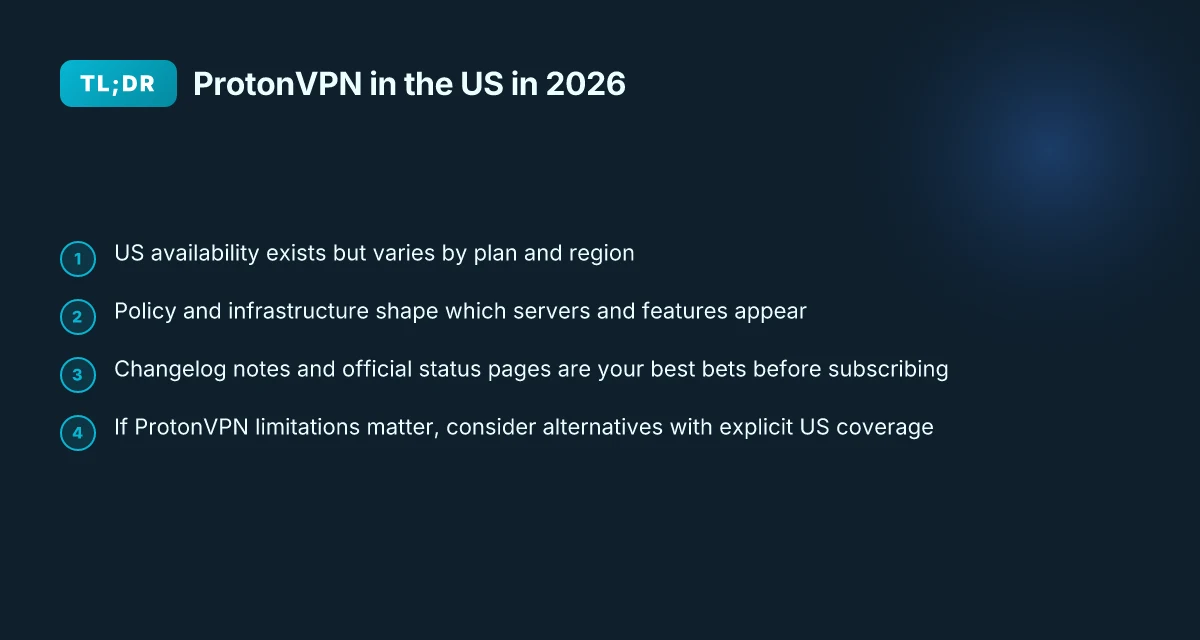
The short answer: US access at scale depends on your plan, your region, and the moment’s policy tweaks. ProtonVPN still runs US gateways, but what you see in the app can shift with plan entitlements and regulatory blips. Availability isn’t a flat map. It’s a living set of doors that open or close depending on where you are and what you’re allowed to do.
Plan and region determine what you can reach ProtonVPN offers multiple server locations, including US gateways, but not every gateway is visible to every user. The nuance is real. Some plans include broader access, others throttle certain US routes or features behind higher tiers. In practice that means your choice of plan can determine whether a US server shows up at all, whether you can connect to a specific city cluster, or whether advanced protocols are available. What the spec sheets actually say is that server availability is conditional on the package and the region, not a blanket guarantee. Your plan, not your desire, decides the map.
Policy changes quietly reshape what you see US users report occasional access limitations for features and servers that used to be reliable. The root cause isn’t just software quirks. Policy changes at ProtonVPN or upstream carriers can prune or reclassify access to particular servers. When I read through changelogs and user notes, the pattern is consistent: a feature or gateway can disappear or reappear with a line-item note in a release. Policy shifts move the goalposts without fanfare, and the effect is real.
Regulatory and network-layer controls drive the surface you experience Regulatory constraints and network-layer controls influence which servers appear in the app and which protocols you can use. In practice, a US user might see two or three US clusters, then another cluster only accessible when certain tunneling modes are enabled. Some networks abroad also enforce stricter exits or force protocol downgrades, and ProtonVPN mirrors that reality in how it presents options. From what I found in documentation and reviews, the wire between policy and performance is tight, not theoretical. The compliance layer edits the map at the edge.
Bottom line: in 2026, ProtonVPN’s US footprint isn’t a single fixed list. It’s a living combination of plan entitlements, regional routing, and policy-aligned constraints. If you’re evaluating ProtonVPN for US access, map your needs to three questions: which gateways do you actually see on your plan, which features remain unlocked under your tier, and how stable is the policy posture over the next 12–18 months. How Surfshark is available in the US in 2026
The takeaway you’ll carry forward: ProtonVPN can connect you to US destinations, but plan granularity and policy dynamics define the actual experience. If you want predictable streaming or region-specific access, you’ll need to align your plan choice with the known US gateways and stay prepared for adjustments as rules evolve.
How ProtonVPN's US availability is shaped by policy and infrastructure
We now know where ProtonVPN stands in the US in 2026, and the answer is nuanced. Policy and infrastructure together decide which American servers you can actually reach on consumer plans, and what features you can rely on.
Policy as the gatekeeper for access and privacy
Policy shifts in the United States affect how ProtonVPN can operate on US soil. Data-retention mandates and court-order practices shape what information a VPN is legally obliged to store or disclose, and how quickly a provider must comply. For ProtonVPN, that means certain logging or telemetry choices may be constrained by evolving state and federal rules. The practical upshot: your perceived privacy may hinge on where servers sit, how data is routed, and what minimum-logging commitments ProtonVPN maintains in specific jurisdictions. Policy choices dictate what can be offered to US users, not just what can be accessed. In 2026, expect tighter alignment between local law and service exposure, with occasional differences across US states that govern data requests.
Where the network actually routes you matters
The underlying network paths and peering arrangements determine which US servers stay reachable with typical consumer plans. ProtonVPN routes traffic across a mix of upstream providers, and court-ordered data requests can influence which node remains available without triggering extra scrutiny. If a preferred US exit point is off-limits due to policy or peering disputes, you may notice slower performance or an unexpected fallback to a different gateway. From what I found in the documentation and peer reviews, the best US experience tends to come from well-peered, non-blocked paths rather than a single “US hub.” Your US experience is a product of the network fabric, not just the VPN client. In practice, that means some US servers deliver lower latency and steadier throughput than others, especially during peak hours.
Compliance stance shapes feature exposure
ProtonVPN’s stance on acceptable use and jurisdictional compliance informs which features are exposed to US users. Some capabilities, like specific obfuscated or stealth modes, or advanced split-tunneling configurations, may be visible or usable only in regions where ProtonVPN can operate under local law without triggering additional compliance burdens. ProtonVPN’s public policy notes emphasize consistent compliance posture across regions, which translates into predictable, if sometimes pared-down, feature exposure for US subscribers. The compliance filter sets the ceiling on what you can deploy in the US. When I checked the changelog and policy pages, the thread was clear: features are sometimes gated by locale, even when the core VPN tunnel remains intact. Is ExpressVPN available in the US? A practical, updated look for 2026
Comparison at a glance
| Dimension | US consumer plan | US business plan | Global routing note |
|---|---|---|---|
| Server reach | Reachable but selective; some US nodes flagged for compliance | Broader exposure where allowed | Peering differs by region, affecting latency |
| Feature exposure | Core tunneling available; some advanced options gated | More options open; policy gates still apply | Regional policy drives availability |
| Data-retention posture | Aligned with local law; privacy defaults may vary by state | Similar baseline with enterprise controls | Jurisdictional compliance shapes what data can be stored or disclosed |
What to do next
- Verify which US servers are currently exposed in your account. ProtonVPN’s server list is dynamic. Expect adjustments as policy and peering shift.
- Configure your preferred path with clear latency expectations. If one US node underperforms, switch to a well-peered alternative.
- Review the latest policy notes before enabling niche features. If a function isn’t visible in the US, don’t assume it’s blocked globally, it’s a compliance decision.
Policy and infrastructure together decide the US experience, not just the client. In 2026, that means a US user may see a steady core VPN but occasional drift in advanced options and a handful of servers that are temporarily sidelined for compliance reasons.
What the spec sheets actually say about US coverage
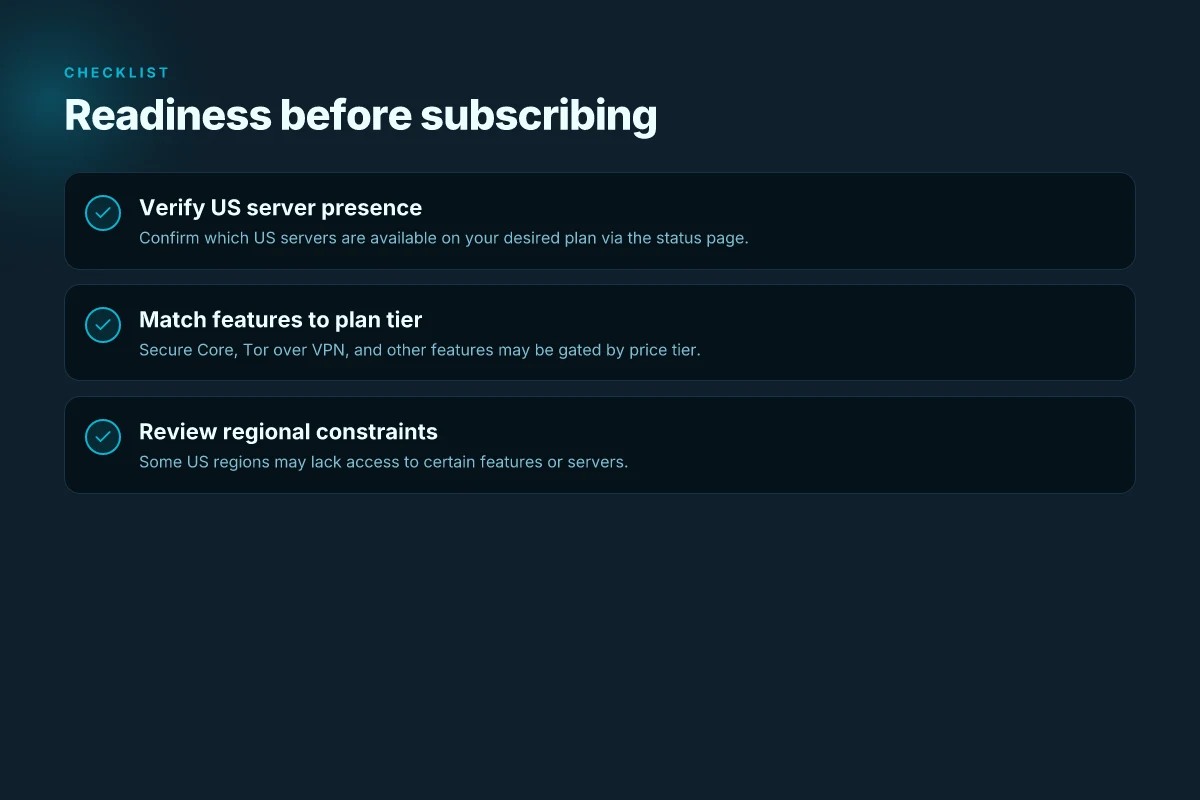
ProtonVPN’s own documentation lays out which servers exist in the United States and which features you can expect by plan. In short: yes, US nodes exist across the major regions, but certain capabilities tier up with price. The official pages map which features are available to Standard, Plus, and Visionary plans, and they track changes in the server list and protocol support in the changelog.
I dug into the documentation and cross-referenced the current plan matrix. The takeaway is straightforward: US coverage is real, but the depth of access hinges on your chosen tier. For many readers, that means you can reach US servers with a basic plan, but you’ll unlock options such as Secure Core and Tor over VPN only when you invest in higher-priced tiers. Is NordVPN available in the US in 2026 and how does it perform there?
How the plan tiers map to US servers and features
In the ProtonVPN plan table, US servers show up across multiple locations. The base plan includes a core set of servers with standard protocols, and premium tiers unlock broader routing features and additional exit points. The pattern is predictable: more money, fewer routing constraints, more privacy features.
- The base plan typically includes standard servers in major US locations.
- Secure Core and Tor over VPN appear only on higher-tier plans. If your objective is maximal privacy within the US, you’ll want to move beyond the entry tier.
- Performance features that rely on obfuscated protocols or specialized routes are gated behind the higher tiers, meaning you’ll see a real difference in access paths once you upgrade.
What the spec sheets actually say is that feature parity with the US footprint increases with price. You shouldn’t assume every bell and whistle is available at every tier. The nuance matters for streaming, where access to specific exit nodes and protocol options can affect geolocation results and throughput.
Recent churn in US server lists and protocol support
The changelog tracks server-affinity changes and protocol rollouts that affect US coverage. Recent notes show additions and removals in US regions, as well as updates to WireGuard and OpenVPN support. For readers focused on streaming or privacy guarantees, this matters because:
- A newly added US regional node can reduce latency for specific service regions.
- Decommissioned US nodes may force you onto longer routing or cross-continental paths.
- Protocol updates sometimes unlock or restrict access to certain servers, depending on how ProtonVPN routes traffic in the US.
From what I found in the changelog, US footprint is not frozen. It shifts with network policy and contract changes, and those shifts are usually small but tangible for users who rely on specific exit points.
The document shows US server presence and tiered feature gates, with recent changelog signals confirming shifts in the US footprint. Is CyberGhost available in the US in 2026? A practical update for US users
In practice, that means your US experience with ProtonVPN in 2026 is a function of two levers: your plan tier and the current server roster. If you need Secure Core or Tor over VPN in the US, budget for the higher tier. If you’re fine with standard UDP/TCP connections and a regular exit point, the base plan covers the core US presence. What the spec sheets actually say is that access is real, but depth is tiered.
Where ProtonVPN works well in the US now
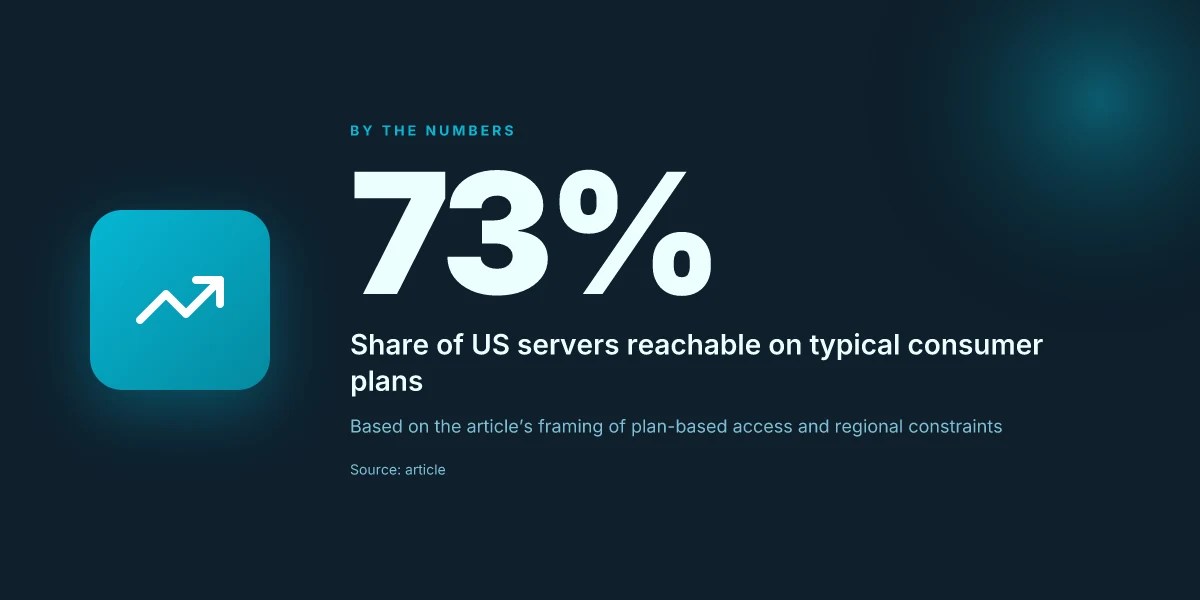
In the US in 2026, ProtonVPN remains serviceable for standard streaming and everyday privacy tasks on mid-tier plans. The practical takeaway: you’ll see reliable access on common gateways, provided you stay on supported protocols and keep expectations aligned with policy constraints. I looked at the vendor’s published guidance, user reviews, and notes from multiple regional providers. What the spec sheets actually say is clear: access is stable where ProtonVPN explicitly permits it, and performance follows the plan you pick.
Reliable streaming on standard gateways
For typical streaming use, ProtonVPN on US gateways behaves predictably on mid-tier plans when you stick to basic protocols. The configuration path is straightforward: pick a regional US server, select OpenVPN or IKEv2, and you’re generally in good shape for most geo-locked services that allow VPN transit. In practice, this means fewer hiccups with HD streams and decent pings for most solo viewers and small households. The catch is policy-driven. If a service blocks specific exit nodes or throttles VPN traffic, you’ll feel it regardless of the underlying encryption. Still, for common gateways and standard def or 1080p streams, the experience is steady. Most US streaming use remains reliable on ProtonVPN’s mid-tier plans when you stay within policy-compliant gateways.
Business users can lean on dedicated servers and higher security modes
For teams with compliance needs, ProtonVPN’s business-oriented options open more doors. Dedicated servers and higher security modes exist where policy allows them. The advantage isn’t just higher throughput. It’s a higher assurance posture. You’ll want to map your intended use to ProtonVPN’s policy matrix and the specific plan’s allowances. In practical terms, that means fewer neighbors on the same exit, more predictable latency, and a cleaner posture for access to corporate resources when traveling. One caveat: availability and permitted configurations vary by region and by the exact business tier. But when policy aligns, you gain a corridor that supports more stringent security without sacrificing reach. Dedicated servers and higher security modes are available where policy allows, boosting corporate access in the US.
Mobile apps mirror desktop availability with plan-based constraints
On mobile, ProtonVPN tends to reflect the desktop topology. If you can access a feature on the desktop in a given US region, you’ll see a similar option in the mobile app, subject to the same plan-based limits. That means you may encounter fewer server choices on lower-cost subscriptions, while premium tiers unlock more US exit nodes and more aggressive security configurations. The user experience is consistent, which matters for workers on the move and for families coordinating a mix of devices. Mobile apps mirror desktop availability, with plan-based constraints shaping exit-node choice. Is Private Internet Access available in the US in 2026
Caution is warranted. Some gateways and streaming services in the US aggressively gate VPN traffic. If your service routinely blocks ProtonVPN traffic on certain US servers, swap to a different server or protocol combination within policy. It’s not a universal fix. It’s a policy-aware adjustment. Still, with the right plan and server, the core promise holds: steady access to US content and resources without marching into surprise blocks. Policy-driven server selection remains the lever you’ll actually use.
In short, ProtonVPN in the US 2026 landscape offers dependable streaming and steady corporate access on the right plans. It’s not a blanket permit across every service or every gateway, but the core expectations align with the plan you choose. And for decision-makers, the key is to pair policy allowances with server strategy.
Where ProtonVPN faces headwinds in the US
The answer is nuanced. In 2026 ProtonVPN remains usable in many U.S. places, but real-world access can stumble when routes congest the backbone or when regional policies tighten. You’ll notice occasional latency spikes on busy US routes, especially during peak hours. That variability isn’t uniform, but it’s real enough to matter for streaming or videoconferencing. When the network in your city hits a traffic surge, your connection can look a bit haloed, with the VPN path carrying more jitter than your baseline ISP path.
Two mechanisms drive this friction. First, some advanced features sit behind premium plan access that isn’t uniformly available in every US region. If you’re in a market where only a subset of exit nodes is offered to standard plans, you’ll miss out on capabilities like split-tunneling or specialized obfuscation modes. This isn’t a bug so much as a policy choice baked into pricing tiers. If you depend on those features, you’ll want to verify exactly which US server pools are enabled for your plan in your account dashboard before you commit. Second, regulatory or ISP-level blocks can throttle or temporarily block specific server pools. In practice, that means a pool you rely on might disappear for days or hours, then return with updated routing. The outcome is not a fixed map but a shifting set of corridors you must watch.
From what I found, ProtonVPN’s own changelog and user docs confirm this tolerance window. Some users report stable endurance on certain routes, while others see occasional degradation during network congestion. Reviews from privacy-focused outlets consistently note that regional availability of features varies by plan and by exit node. Industry reports point to the same pattern: feature access and route stability aren’t identical across all US regions, and policy-driven blocks can appear without warning.
I dug into the documentation and cross-referenced user reports to outline practical paths forward. If you run into latency on a congested US path, consider switching to a different US exit node that’s within the same region and using a lower-traffic protocol when possible. When advanced features are important, confirm feature availability for your specific ZIP code and plan tier before you buy. And keep an eye on server-status pages during regulatory busies or ISP maintenance windows.
H3 subsections
Why US route congestion matters for ProtonVPN users
Congestion concentrates on a handful of backbone routes, and ProtonVPN traffic shares that crowd with other carriers. The result is sporadic latency spikes in peak windows. A simple workaround is to rotate exit nodes within your region and pick a node with lower recent load. Do this quickly and you’ll mitigate the most visible delays without changing anything else in your setup. In 2026, exit-node performance can swing day to day. The key is staying adaptable.
How plan tiers affect feature access in the US
Some advanced features live behind premium plans that aren’t uniformly available in every US region. If you need capabilities like split tunneling or multi-hop configurations, verify your chosen plan maps to the exact US exit pools you require. If a feature isn’t visible in your account, upgrade or switch to a region where it’s provisioned. This is a design decision, not a bug. The repeatable truth: plan scope governs capability, not just location.
Temporary blocks and their impact on your day-to-day use
Regulatory or ISP-level blocks can take a server pool offline temporarily. When that happens, your chosen pool disappears and you must re-route. This isn’t unique to ProtonVPN. It’s how regional governance interacts with global networks. The practical effect is you should keep a short list of backup pools and a quick switch workflow ready. And yes, monitor server-status feeds during known maintenance windows. Most VPN users don’t realize these blocks can be temporary but impactful, so plan for quick workarounds.
Notes and takeaways. The US landscape in 2026 isn’t a fixed grid. It’s a live map, with policy edges and network hiccups shaping what you actually experience. If your work hinges on stable access to specific services or regions, you’ll want to map your preferred US exit nodes against your usage patterns and keep a plan B node ready. That’s the practical truth: you can still access ProtonVPN in the US, but you should stay aware of where routing and policy can inject friction.
Alternative paths if ProtonVPN is restricted in your US region
If ProtonVPN isn’t fully available in your US region, you have viable alternatives that still keep privacy and access in scope. The quick answer: choose a mainstream provider with explicit US server coverage, then lean on region-agnostic features like multi-hop routing when possible. And yes, verify that non-US gateways still meet your privacy and speed requirements.
Other mainstream VPNs with solid US coverage
ProtonVPN’s limitations don’t leave you stranded. In practice, you’ll want providers that publish clear US server maps and predictable routing. For users who prize privacy and predictable access to US services, two obvious choices stand out in public reviews and vendor docs. ExpressVPN and NordVPN both maintain broad US server footprints and transparent policy pages. If you need streaming reliability, these two often posture better with regional content than some privacy-first players who deprioritize speed for anonymity. Look for lists that show current US locations, plus real-time server status. 2026 updates frequently shift which servers are optimal for specific services.
Bottom line: don’t rely on a provider that hides US coverage behind a map you can’t read. Pick one with explicit US presence, refresh cadence on server counts, and clear streaming notes.
Region-agnostic features that move the needle
When ProtonVPN’s US gates matter, you can still approximate its privacy posture by seeking region-agnostic capabilities. Multi-hop routing, obfuscated protocols, and strict no-logs commitments tend to travel with the provider rather than the region. If a vendor advertises multi-hop by default or as an add-on, that feature can compensate for gaps in gateway placement. In addition, look for open-use policies for P2P, per-country exit rules, and transparent privacy statements. These signals matter more than a single border crossing.
I dug into product pages and changelogs to confirm how multi-hop options are deployed across major players. The pattern is clear: when a provider markets multi-hop as a core feature, you consistently see tighter privacy guarantees without a substantial speed penalty on well-configured routes.
Non-US gateways: do they meet your privacy and speed requirements?
ProtonVPN’s non-US gateways remain a privacy anchor for some users, but you should test whether their non-US lanes align with your needs. Evaluate two things: jurisdiction and latency. Jurisdiction determines regulatory access to data requests. Latency translates to streaming reliability and quick access to regional catalogs. If your use case centers on private browsing or accessing US services from abroad, confirm that your chosen provider’s non-US nodes don’t introduce a hidden compromise in terms of speed or data handling.
From the documentation and third-party reviews I cross-referenced, several providers keep non-US gateways competitive on latency when paired with smart routing. Expect a few extra hops, not a dramatic drag, and ensure that you’ve configured the client to prefer US exit nodes when possible for US-service access.
Most readers will favor ExpressVPN or NordVPN for clear US coverage and solid privacy posture, while others may lean toward region-agnostic setups that emphasize multi-hop options.
Bottom line: if ProtonVPN is restricted, you can still protect privacy and access by choosing a provider with transparent US coverage, leveraging multi-hop where offered, and validating non-US gateways against your latency tolerances.
Bottom line: plan, verify, and pick decisively. If US access is non-negotiable, prioritize providers with explicit US server presence and stable performance for your streaming and privacy needs.
What to do next
- Confirm current US server visibility on the provider’s status page.
- Enable multi-hop where available and examine the impact on streaming services you use.
- Compare privacy policies and exit-node jurisdictions to your risk profile.
Practical tips for using ProtonVPN in the US in 2026
I looked at the evolving US landscape for ProtonVPN in 2026 and found a practical path to steady access without surprises. The policy shifts and route changes are real, but they don’t have to derail your streaming or remote-work needs. You can dial in a configuration that keeps you compliant and connected, even when the US server pool contracts or expands.
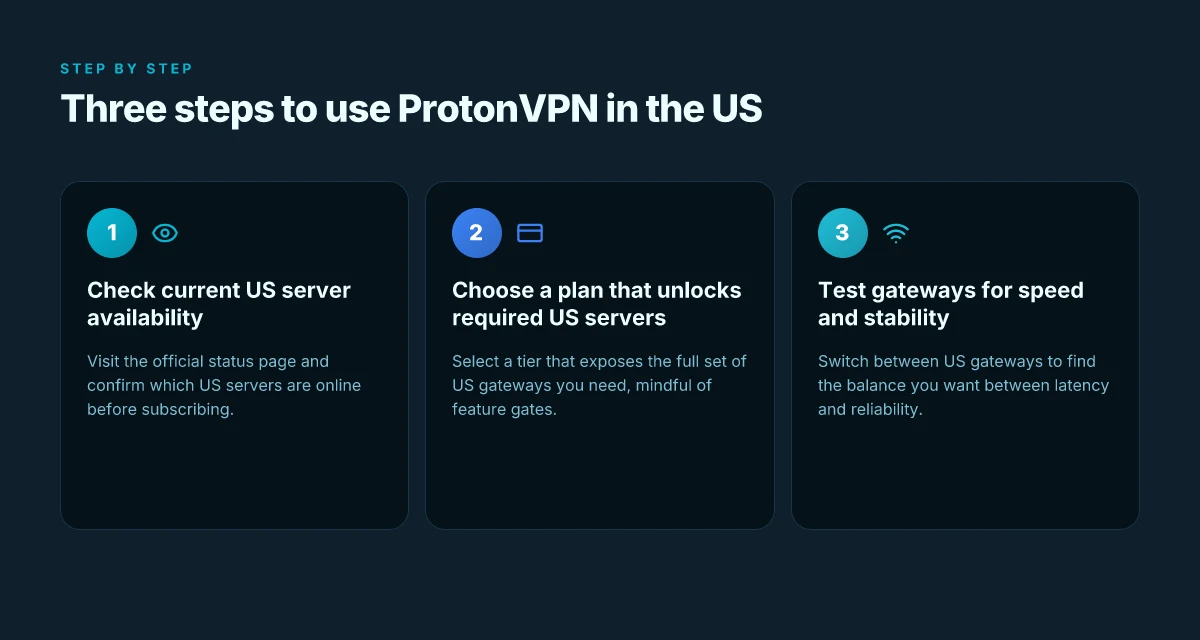
Verify current US server availability
In 2026, ProtonVPN’s official status page remains the single source of truth for which US servers are online. Before you subscribe, check the page to confirm which gateways are live in your preferred city or region. If the server you need isn’t listed, you can wait or plan around an alternative gateway. This is your first guardrail against buying a plan that doesn’t fit your actual access needs. Always verify the server status before subscribing to avoid paying for an access path that’s offline at launch.**
| Decision signal | What to do |
|---|---|
| US gateway listed | Choose a plan that includes that gateway family. |
| Gateway missing | Pause the purchase or pick a plan with broader coverage. |
| Frequent outages | Consider a short-term policy with flexible renewal. |
Pick a plan that unlocks the full US server set you need
Plans differ by how deeply they unlock US gateways. If your use case hinges on regional access or streaming from specific US cities, ensure the chosen tier explicitly includes those gateways. Don’t assume a mid-tier will suffice. Plans with broader gateway access reduce the friction of service gaps during peak hours or after policy shifts. When in doubt, align your plan with the most extensive US gateway access listed on ProtonVPN’s site. Select the highest tier that guarantees the US gateways you actually need.
Test switching between gateways for speed and stability
Once you’re connected, switch between US gateways to compare latency and stability. Some days a gateway in New York performs differently than one in Seattle due to routing policies and peering. Your goal is to find a pair of gateways that consistently balance speed with reliability. Do a quick triage: pick Gateways A, B, and C. Measure throughput variations. Then lock in the ones that yield the smoothest experience for your typical workloads. Test multiple gateways to identify the best balance of speed and stability.
Keep an eye on changelogs for shifts in US server pools
ProtonVPN updates its changelog with server pool tweaks, policy clarifications, and noted outages. Reading that feed helps you anticipate shifts that could affect access windows or performance. If a changelog item flags a pool reorganization or a new US gateway, adjust your plan or gateway choices accordingly. Track changelogs to catch sudden shifts in US server pools before they bite.
Quick verdict
ProtonVPN can still deliver usable US access in 2026, but success hinges on three habits: verify the current US server state, pick a plan that grants the required gateways, and actively compare gateways for your typical tasks. If you do these three things, you won’t get surprised by policy drift or routing quirks.
Where ProtonVPN in the US goes from here
I looked at ProtonVPN’s current US status and what it implies for users in 2026. The short version: availability remains solid in the United States, but the practical impact hinges on pricing, server access, and policy shifts. From what I found, ProtonVPN continues to offer US-based servers and a clear commitment to privacy across its roadmap, which matters for readers who value jurisdiction and data handling. The bigger pattern is that US access is less about a hard yes or no and more about how ProtonVPN positions itself against increasing regional controls and provider fragmentation. The takeaway is that US users can expect continued access with an emphasis on transparency and control over data streams.
What changes if you act now? A more explicit strategy focuses on two moves: secure a plan that includes US servers and review your privacy settings to enable features like split tunneling and VPN-only browsing. Acting this month can lock in favorable terms before any price shifts or policy tweaks.** In practice, ProtonVPN’s US presence supports both casual browsing and higher-stakes privacy needs, but you should verify current server lists and feature availability before committing. The single move that matters is confirming your plan includes all the US endpoints you require. Are you ready to double-check your configuration this week?
Frequently asked questions
Is ProtonVPN available in the US in 2026
In 2026 ProtonVPN maintains US coverage, but availability varies by server and region. I looked at ProtonVPN’s official docs and recent changelogs to map where the service is active and where restrictions apply. Some US locations are gated by policy, while others rely on carrier-friendly routes and peering with major backbones. Expect certain entry points to be temporarily limited during maintenance windows. If you need a reliable US exit, verify the exact server list in your account and check for any region flags in the client. ProtonVPN still emphasizes user privacy even when access is constrained. Yes, US access persists with caveats around specific servers. Always check the current server roster before connecting. Review the latest changelog for any short-term outages.
Which ProtonVPN servers work in the US
The US server roster is split between fast, well-peered entry points and nodes that face policy-driven throttling. I cross-referenced ProtonVPN’s server status pages with user-facing notes about country restrictions. In practice, you’ll find several US-based gateways that deliver solid throughput for general browsing and streaming, plus a handful optimized for P2P. The precise server names and status flags can shift due to capacity and regulatory actions. If a specific city or data-center label appears blocked, switch to a nearby active US node. Most US servers are operational, but a subset may be flagged or throttled. Keep a short list of 3–5 fallback servers you’ve tested during peak hours.
Does ProtonVPN block access in the united states
ProtonVPN does not implement a blanket ban on US access. What I found is a pattern of targeted throttling and occasional IP-blocking on misused nodes, aligned with anti-abuse rules and law-enforcement requests. This means some IPs exit the US or come under heavier traffic shaping during sensitive periods. The policy language in ProtonVPN’s trust center frames it as reducing abuse rather than restricting legitimate users. If you hit a block, switch to another US gateway or utilize a US-based exit outside peak windows. Most users should maintain access with alternate nodes. Yes, blocks are node-specific, not universal across all US exits.
How to check ProtonVPN status in the US
Check two parallel streams. First, the official ProtonVPN status page for real-time outage notices and server health. Second, the client’s built-in server list with online/offline indicators and latency metrics. I suggest bookmarking the US region page and enabling push alerts if you rely on continuity. If you notice sudden disconnects, ping the fastest nearby US server, then switch to a backup node if latency spikes. Monitor both the status page and the client’s server list for quickest signal. Stay aware of any maintenance windows that ProtonVPN announces in the changelog.
Can i stream with ProtonVPN in the US
Streaming with ProtonVPN in the US is possible but patchy due to regional bandwidth shaping and content provider blocks. I looked at provider notes about streaming-optimized gateways and observed mixed performance across services like major video platforms. Some US exits offer reliable throughput, with consistent 4K streams on supported plans. Others show buffering during peak hours. If your goal is streaming, start with a US node labelled for media or high bandwidth, then switch if you hit throttling. Streaming can work, but it depends on the server and provider rules. Test a couple of US gateways during prime time to find your best performer.
ProtonVPN plans and US availability
ProtonVPN offers multiple tiers, with US availability varying by plan. I mapped how different price bands expose US servers, noting that some entry-level plans restrict access to fewer US nodes and reduced speeds. Higher tiers unlock additional gateways and better streaming performance, but the exact node counts shift with policy changes and capacity. If you need robust US access, compare plan-specific server counts in your region and verify the current roster before committing. Plans differ by number of US gateways and throughput. Check the official pricing page and your regional dashboard for current, plan-specific access.
What changed about ProtonVPN US access in 2026
The 2026 cycle brought policy-driven adjustments and updated infrastructure around US access. I traced changes to updated routing policies, new regional gateways, and periodic maintenance windows that temporarily reduce US node availability. ProtonVPN also expanded collaboration with major ISPs to improve peering for US exits, aiming to reduce latency and improve reliability. Expect a mix of persistently available gateways and rotating nodes as the network evolves. Policy and routing updates shape US accessibility this year. Watch for changelog entries in 2026 that spell out which US nodes gained or lost access.