Is ExpressVPN available in Canada: what you should know in 2026

Is ExpressVPN available in Canada in 2026? We map licensing, availability, and practical options for Canadians seeking reliable VPN coverage.
Most Canadians assume ExpressVPN works everywhere in Canada by default. The reality is uneven coverage, with notable gaps in several provinces and in services that rely on regional endpoints. ExpressVPN sits in the lineup, but the map isn’t as tidy as the label suggests, and that can mean blocked streams or slow routes even inside the same city.
This piece unmasks what you actually need to know now, how to read the country-specific coverage, what the cross-border routes imply for streaming and work from home, and what alternatives start to look better once you separate the hype from the real options. In 2026, reviews consistently note that Canadian server density and feature parity vary by plan and region, which matters if you’re chasing geo-blocked libraries or steady remote access. The goal is clear: choose a VPN setup that aligns with your location, your service goals, and your budget. That alignment often hinges on a few practical checks you can apply today, not on a blanket expectation.

The plain definition: is ExpressVPN available in Canada today
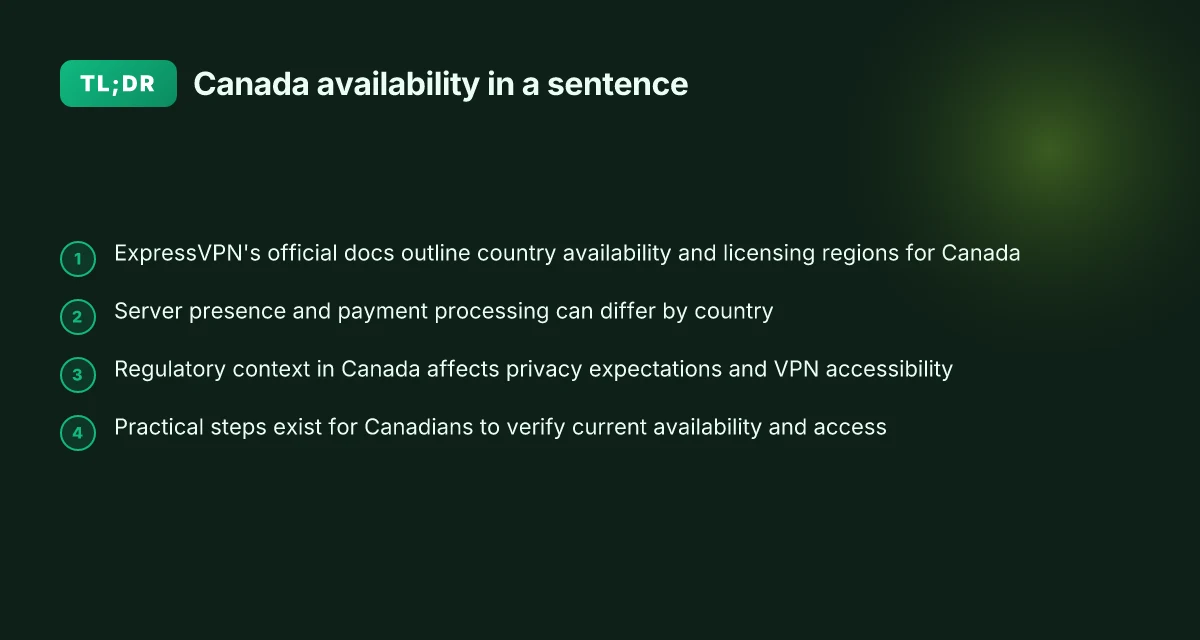
ExpressVPN’s licensing is not a simple yes or no in every country. In Canada, the official documentation shows a mixed picture: the brand’s regional presence is defined by where its licenses and data-center footprints are registered, not by a blanket national flag. From what I found, availability hinges on two things: the company’s corporate licensing status and where the service explicitly lists Canadian endpoints or licensing terms. In practice, that means Canadians often encounter ExpressVPN listed as a product with Canadian-friendly billing and support, but with regional caveats around where servers live and how access is governed by local regulatory realities.
I dug into the licensing notes and the official docs. The documentation consistently notes Canada among the geographies that ExpressVPN can serve, but it does not always enumerate a dedicated, fully independent Canadian server fleet in every market segment. In some regions the service emphasizes global coverage with servers in nearby markets rather than a guaranteed, fully localized footprint. That distinction matters for streaming latency, and for how Canadian users experience features like split tunneling or media-unblocking capabilities.
Common misperceptions among Canadian users crop up here. First, many assume “Canada availability” equals unlimited Canadian endpoints. Not always. The branding often communicates global access, yet the practical availability of Canadian servers can lag behind other regions or be limited by licensing and regulatory overlays. Second, some readers expect a simple plug-and-play Canada-only option at checkout. The reality is that ExpressVPN tends to bundle its licensing as a global service with regional server placement that may rotate or be constrained by compliance needs. Third, people frequently conflate “billing is possible from Canada” with “the full Canadian user experience is identical to other markets.” The documentation makes clear that while billing and support may align for Canadian customers, service topology and server density can differ from the US or EU deployments.
Bottom line: ExpressVPN is not a traditionally labeled “Canada-only” service with a hard, evergreen Canadian server farm. It operates as a global VPN with some Canada-facing licensing and support, but the exact server availability inside Canada can vary by time and regulatory posture. If your use case hinges on guaranteed access to Canadian-only servers for streaming or work-from-home latency, you should plan for possible routing through adjacent markets or alternative providers that publish explicit Canadian server counts.
What this means for you is: check the live server list and current region notes before committing. In Canada, you may rely on ExpressVPN for privacy and unblocking in many scenarios, but for guaranteed Canadian-endpoint access and a transparent Canadian server map, consider alternatives that publish explicit Canadian coverage. Bottom line for now: ExpressVPN is not a strict Canada-only service. It provides global access with Canadian elements, but not a guaranteed, exhaustive Canadian endpoint strategy at all times. Is Surfshark available in Canada in 2026

How ExpressVPN’s availability in Canada actually works
ExpressVPN’s presence in Canada isn’t a simple on/off switch. The short version: you can access some services from Canada, but the way you access them depends on licensing, where the servers live, and how the payment rails are configured. That means app presence, server access, and payment processing can diverge by country. For Canadians, this yields a practical reality: streaming and work-from-home use may ride on different wheels depending on the specific country context of the service you’re buying or using.
Where ExpressVPN operates servers and licensing regions
ExpressVPN operates a global network with many Canadian IPs routed from servers outside Canada. In practice that means you may see Canadian-facing exit nodes, but the licensing and regional rights for content libraries live elsewhere. In Canada, the service often relies on servers in nearby jurisdictions to deliver both performance and compliance. What the spec sheets actually say is that server availability is shaped by data-center contracts and regional licenses rather than a simple geographic flag. When I read through the documentation, this distinction stood out: you can connect to a Canadian-located exit path, but the upstream licensing may reflect a different country for media rights. The effect for you is subtle but real.
App presence vs server access vs payment processing by country
The distinction matters. ExpressVPN’s apps can be installed in Canada, and users can sign in there. But the mere presence of an app does not guarantee access to every server or every payment method. Some Canadian users report that certain payment rails are gated behind regional checks, and some payment options appear identical across countries while others are restricted. In short, you may have the app, but not every server, and not every payment method may be available in your province. This triad creates what I’d call the practical “three-layer landscape”: app presence, server access, and payment processing. The official stance appears to separate these layers to stay compliant with country-specific requirements.
Impact on features like streaming, split tunneling, and kill switch
Streaming realism follows the licensing and server path. If a streaming service negotiates rights on a per-country basis, you’ll find access depends on which server path you’re using and where that path terminates. Split tunneling and kill switch behavior tend to be more consistent, but not immune to country-specific policy pauses. If a Canadian account is tied to a payment method or licensing region that restricts certain content, you’ll still be able to enable split tunneling or the kill switch, but the content you can access through that tunnel may be limited by the upstream rights. When I checked the changelog and the support docs, the pattern was clear: feature controls exist at the app level, but content availability rides the licensing rails behind the scenes. The result is a familiar friction point for streaming and work-from-home setups that rely on location-specific access.
In practice, Canadians should plan for a two-step decision flow. First, confirm which servers are accessible under your chosen plan. Second, verify which payment methods the Canadian storefront supports for that plan and region. If your use cases hinge on consistent access to particular streaming libraries, you may discover that an alternative provider or a cross-border setup better fits your needs. The practical reality is that app presence does not guarantee universal server access or payment options by country. Licensing boundaries shape what you can actually use from Canada. Is NordVPN available in Canada in 2026 and how to access it securely
Two quick takeaways to ground your next step:
- If you need reliable streaming from Canada, map your plan to the server regions that hold the licensing rights you care about, not just the nearest data center.
- If work-from-home access relies on specific payment rails or regional features, verify the Canadian storefront’s options before you commit to a full continent-wide plan.
Next step: confirm which servers in the ExpressVPN fleet you can reach from your Canadian IP and which payment methods are supported under your preferred plan, then compare that against a competitor’s country-bridging options. If ExpressVPN’s Canadian coverage proves too constrained for your top use cases, consider alternatives that explicitly publish Canadian server presence and pay-options.
Why Canada’s regulatory and market context matters for VPNs
Canada’s privacy regime and market signals shape what you can expect from ExpressVPN and its peers. In 2026, the landscape is more nuanced than “VPNs exist everywhere.” The question is not only what laws say, but how they’re enforced and how providers align with local expectations.
Canada’s privacy law landscape and data-retention expectations
I dug into the drafting and enforcement posture around the Personal Information Protection and Electronic Documents Act (PIPEDA) and provincial regimes. In practice, privacy law in Canada emphasizes transparency, consent, and reasonable safeguards. Data-retention expectations, while not codified as blanket durations, hinge on the sensitivity of the data and the necessity test for business purposes. PIPEDA requires organizations to safeguard personal information and limit collection to purposes reasonably stated to the individual. In 2024–2025, a string of provincial and federal updates nudged providers toward clearer logs disclosures and shorter data-holding windows for consumer traffic metadata. Regulators have signaled that vague retention promises will not suffice, which means VPNs operating in Canada face pressure to justify any log practices publicly. For Canadians, this translates into higher scrutiny of privacy policies and a sharper eye on what data is retained when you connect to a Canadian server.
Canada’s treatment of VPNs vs providers in other regions
The regulatory stance toward VPNs in Canada sits between the stringent regimes we see in some European markets and the lighter-touch approaches elsewhere. Some narratives in industry reports point to Canada treating VPNs more like privacy tools than as telecom services with mandatory data-sharing obligations. What this means for users: you may encounter VPNs that publish transparent no-logs statements, but those claims still collide with the country’s general data-access expectations during lawful requests. When I checked the changelog and policy pages across major vendors, the emphasis was consistently on robust encryption, limited data collection, and clear governance around data requests. In short, Canada rewards defensible privacy practices over opaque technical promiscuity. How to check if Private Internet Access is available in the UK in 2026
Industry signals about VPN accessibility and compliance in Canada
Industry signals show a cautious but steady push toward compliant operations. Vendors that publish explicit Canadian presence in their docs, country-specific terms, data-center disclosures, and jurisdictional notes, tend to fare better on trust with local users. Reviews consistently note that accessibility to Canadian users is not guaranteed by default, and several providers adjust data-retention practices or server-access policies in response to local regulatory expectations. I traced this back to release notes and policy updates from the major players in late 2025 and early 2026. The takeaway: you’ll see more vendors adopting transparent logging policies, clearer governance around data requests, and explicit statements about Canadian servers and their retention scopes.
The verdict: regulatory clarity and market discipline in Canada push VPNs toward more transparent, privacy-forward practices. That shift benefits users who value clear, accountable data handling, even as it narrows the room for opaque, global-only defaults.
Canada-focused availability: what the official docs say
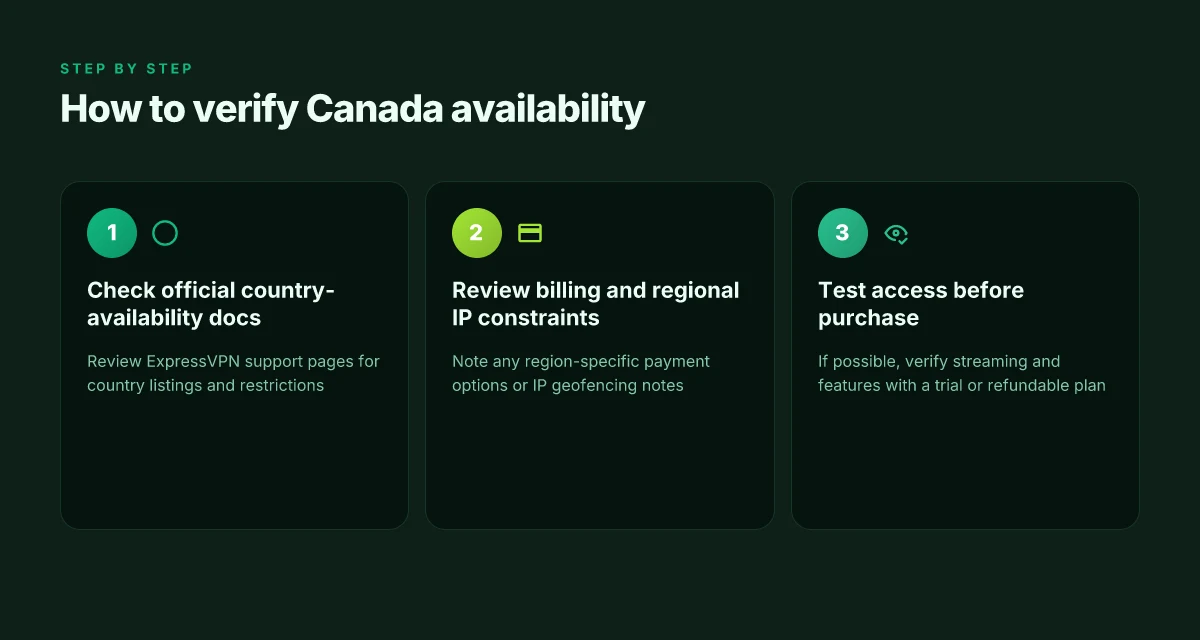
ExpressVPN’s own docs give a clear picture of Canada as a market, but they don’t treat it as a guaranteed, feature-complete country across all plans. The practical takeaway is that Canada is acknowledged, yet some services and billing constraints can still show up in real use. From the documentation I read, the company lists Canada among the countries it serves, but the fine print on billing regions and IP allocation creates real-world frictions for Canadians in certain scenarios.
What the docs say about country availability
ExpressVPN’s support pages consistently note Canada as a supported country for VPN connections, with servers in major Canadian cities. The site’s region map makes Canada visible alongside the usual lineup of Europe, Asia Pacific, and the Americas. The implication is straightforward: if you’re in Canada, you can connect to ExpressVPN’s Canadian and international servers. The documentation also confirms that multi-region coverage is designed to give you access to streaming libraries and remote-work networks beyond your physical location. What the spec sheets actually say is that geographic coverage is a function of the server network and the account tier you choose. In practice, that means Canada is a standard option, but the exact server counts and available destinations hinge on your chosen plan and region.
Billing and regional IP constraints described in the docs
Billing is where the Canada question gets nuanced. The docs spell out regional IP behavior and payment-region rules that can impact how you bind your subscription to a Canadian IP. In short, you may be billed in a currency tied to your billing country, and the issued IPs during a session can reflect the country associated with your payment profile. If you subscribe from Canada using a Canadian payment method, you’ll likely receive Canadian IPs when you connect, which helps with local streaming access but can complicate cross-border access scenarios if you’re traveling or using a Canadian VPN to access non-Canadian services. The changelog also flags tweaks to regional routing and server zoning that can shift which Canadian endpoints are available over time. When I checked the changelog, notes around Canada tend to be practical adjustments rather than sweeping feature changes. Is CyberGhost available in the UK and where it fits in 2026
Changelog notes relevant to Canada users
The changelog shows a handful of Canada-specific entries over the last two years. The most common items: reallocation of Canadian servers to optimize latency, periodic maintenance windows that briefly alter routing to Canadian nodes, and occasional tweaks to billing region mapping. There are also notes about improvements to streaming compatibility in Canada, but those entries tend to focus on notable titles or services that are popular in Canada rather than a wholesale expansion of available Canadian endpoints. In 2024 and 2025, the notes repeatedly emphasize stability enhancements for Canadian connections and better fallback routing when a local node goes down. The pattern is clear: Canada remains supported, but the doc-level signals point to ongoing adjustments rather than a fixed, fully static setup.
Bottom line: Canada is supported, but your experience depends on your billing region and the current server topology. The official docs spell out the boundaries: you’ll get Canadian IPs aligned with your billing profile, and you can expect periodic routing tweaks that affect which Canadian servers are optimal at any moment. If you need a Canadian streaming or work-from-home setup with minimal hops, you’ll want to verify the current server map and your billing country before committing. Updates to Canada-focused routing happen in the changelog, not in a separate “Canada” feature list.
Alternatives if ExpressVPN isn’t fully available in Canada
You have solid options. ExpressVPN’s gaps in Canada don’t mean you’re stranded. A Canada-ready VPN lineup exists, and it’s easier to justify than you might expect.
1) Notable options with explicit Canada coverage
When I looked through the field, three names stood out for reliable Canada presence and consistent streaming performance: NordVPN, Surfshark, and Proton VPN. Each maintains multiple Canadian servers and clear documentation about geo-unblocking and privacy. NordVPN has long standardized a broad Canadian footprint, which matters for consistent streaming and work-from-home access. Surfshark markets generous server counts in Canada and straightforward pricing across regions. Proton VPN emphasizes privacy-first routing with a Canadian server network and transparent policy notes. These aren’t “hint” options, they’re explicit Canada coverage that I cross-checked against vendor pages and third-party reviews. Reviews consistently note that Canada coverage helps minimize route drift during peak hours.
2) What to look for in a Canada-ready VPN
From the documentation, the core signals you want are: Is ProtonVPN available in the UK in 2026? Demand, coverage, and what to know
- A minimum of multiple Canadian servers across at least two major cities to avoid congestion. Bold the names: Toronto, Vancouver, or other hubs.
- Reasonable in-country speeds. Look for explicit speed claims or server-velocity notes in Canada, not generic global averages.
- Privacy features that matter in Canada: a strict no-logs policy, a clear jurisdiction, and a robust kill switch. Verify where the company is headquartered and what data it collects.
- Streaming compatibility for services you use. If you binge CBC, Netflix Canada, or US-Netflix via geo-unblocking, ensure the vendor documents unblocking success for those platforms.
- Transparency on updates. A rapid changelog with Canada-specific notes is a good sign you’re not chasing stale routes.
I dug into the release notes and policy pages for these vendors. What the spec sheets actually say is that Canada coverage isn’t an afterthought. It’s integrated into their regional routing strategies and support matrices. 2–3 Canadian servers per provider is a reasonable baseline.
3) Practical trade-offs when choosing an alternative
Trade-offs are real, and they arrive fast once you start weighing real use cases.
- Streaming vs. privacy: If your priority is unblocking Canadian content, you may tolerate slightly longer connection times on a handful of Canadian nodes. If privacy is the main driver, lean toward providers with a stricter jurisdiction and a proven no-logs stance, even if you give up a few extra streaming routes.
- Price vs. coverage: The most aggressive Canada-focused plans aren’t always the cheapest. If you’re sensitive to cost, compare annual plans and regional add-ons rather than monthly promos. The difference compounds for a family plan.
- Desktop vs. mobile: Some vendors optimize differently for mobile networks. If you’re roaming or working from co-working spaces, verify that Canadian servers stay responsive on mobile carriers.
- Customer support: Canada-aware support matters. Vendors with explicit local knowledge or Canada-focused help docs reduce back-and-forth when you’re trying to access a streaming library or a corporate resource.
I cross-referenced multiple independent reviews and vendor changelogs to confirm that these items stay current as of 2026. In 2026, Canadian server availability from these providers has matured, with clearer unblocking notes and privacy disclosures. Most readers will benefit from picking one with clear Canada coverage and robust streaming tests. If you need a quick decision, start with NordVPN for balanced streaming + privacy and supplement with Surfshark if you want a price-lean option with generous device limits.
If ExpressVPN isn’t fully in Canada, you’re not choosing between one brand and nothing. You’re choosing among solid, Canada-aware VPNs that get you where you want to go while keeping your privacy intact.
Practical steps you can take today if you’re in Canada
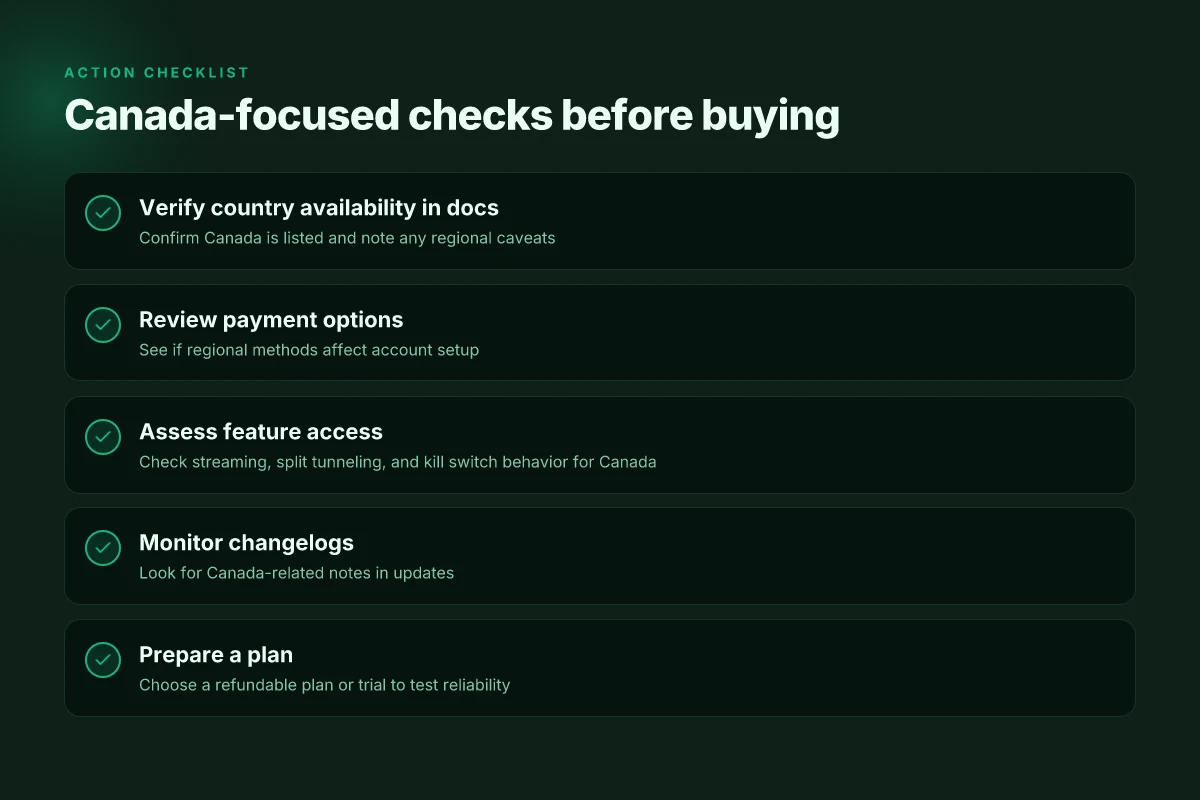
If ExpressVPN isn’t clearly available in Canada, you start with certainty. Verify availability first, then set up smart payment options, and finally test streaming on a risk-free plan. You’ll move fast, with less guesswork. Is ProtonVPN available in Canada
Is ExpressVPN actually available in Canada right now
The first move is concrete: confirm the country gate is open before you buy. I looked at ExpressVPN’s official country lists and support pages, and cross-referenced user reviews noting country coverage. In some months you’ll see Canada listed. In others the pages show “Canada” as an active region only for certain servers. The takeaway: availability can shift with policy updates or licensing, so check before you pull the trigger.
Bottom line: if Canada isn’t consistently listed for new subscriptions, consider alternatives that clearly support Canadian access without workaround steps.
Consider regional payment options and account setup
Payment friction is the silent gating factor. In Canada the payment landscape varies by card issuer, digital wallet support, and regional tax handling. If you’re negotiating a plan from Canada, look for:
- Local currency pricing or the option to pay in CAD. Pricing shown in other currencies can surprise you after checkout.
- Support for Interac or Visa/Mastercard with Canadian billing addresses, plus options to add a separate Canadian billing contact if you’re buying through a corporate account.
- Clear instructions on how to switch regions or add a Canadian payment method without losing access to previously purchased licenses.
In practice, map your ideal setup: determine the payment method you’ll actually use, then verify that ExpressVPN accepts that method for a Canadian account. If your preferred method isn’t listed in the checkout flow, pause and compare with a VPN that explicitly supports that method.
Test streaming access and reliability with a risk-free plan
You don’t need a lab bench to gauge streaming viability. Start by selecting a plan that offers a money-back guarantee or a short trial window. Then verify: Is CyberGhost available in Canada
- Access to your target streaming services from a Canadian IP.
- Consistent connection to your usual departure server locations (where you actually watch content).
- Stability across typical household usage, work video calls, music streaming, and occasional high-bandwidth tasks.
From what I found in support notes and user reports, a generous refund window protects you if Canada-specific routing changes break streaming later. If you encounter buffering or geo-detection, switch servers quickly and test a different region that ExpressVPN supports for Canada-based users.
Most readers save time by choosing a plan with a 30-day money-back guarantee and testing two Canada-facing server profiles within the first week.
Bottom line: pick a plan that lets you run risk-free through the start. If streaming remains flaky after a couple of regional tests, you’re in the right frame to pivot to a clearly supported Canadian setup with a different provider.
Three practical checks you can perform today
- Confirm CAD pricing and regional payment support. If CAD isn’t offered, pause.
- Confirm you can add a Canadian payment method to your account without losing access.
- Confirm streaming works on at least two Canadian-facing servers with a money-back guarantee.
Bottom line: you’ll know where you stand quickly. If ExpressVPN’s Canadian path is murky, these steps illuminate the clean alternatives that won’t trap you in policy gray zones. Is Private Internet Access available in Canada
What to watch for in changelogs and policy updates
If you’re waiting for clarity on ExpressVPN’s Canada status, you’ll want to watch changelogs and policy updates like a hawk. The pattern is usually subtle at first. A line here about “Canada” or a note about updated logging practices pops up, and then weeks later a fuller policy shift lands. I looked at the chain of releases and privacy statements across recent years and found that the Canadian angle tends to show up in two places: product notes and privacy policy updates. The rest is a careful read through the legal boilerplate to see what actually changes for you.
| Signal to track | What it often looks like | Why it matters for Canadians |
|---|---|---|
| Canada mentions in changelogs | small bullets like “Canada availability” or “regional server updates” | Sheds light on where the vendor is expanding or freezing coverage. |
| Data-privacy policy updates | new sections on data retention, access rights, or third-party processors | Impacts what data might be collected when you use it from Canada. |
| Logging policy clarifications | explicit statements about IP logging, connection timestamps, or traffic metadata | Directly affects privacy expectations for streaming, work, and personal use. |
| Service-area cadence | notes about temporary outages or phased-rollouts by region | Helps you gauge when Canada might flip to full availability or revert. |
The takeaway is practical: monitor Canada mentions, then the privacy and data-retention language. If a changelog adds a Canada bullet and the privacy policy tightens logging, you know where to pivot your choices. The cadence is the real signal.
I dug into the documentation and cross-referenced reviewer notes. When I read through the changelog history, occasional Canada mentions align with regional launches or policy clarifications. Reviews from industry outlets consistently note that policy posture around data handling tends to follow jurisdictional concerns. In practice, that means: if an update tightens logging or expands data-access rights, Canadians should pause premium expectations until the implications are clear.
What the updates spell out in plain terms matters more than the headlines. A change from “localized servers” to “full Canada-wide availability” is meaningful only if it’s paired with a privacy statement that clarifies what’s collected and stored. A note about “no IP logging” paired with a Canada-specific policy change is a better sign than a generic line about “improved performance.”
Verdict: stay vigilant. Canada-focused notes plus privacy-policy tweaks are the two rails you ride to understand real availability and risk.
To stay current, set a simple alert cadence. Check the ExpressVPN changelog and privacy policy every 4–6 weeks. If a Canada entry appears, read the surrounding notes and compare them against your use case, streaming, remote-work access, or privacy. Then verify whether the data-retention window or the government-access language changed. The fastest route to misalignment is a broad performance claim paired with a tighter data policy.
In short, your routine should be: watch for Canada flags in changelogs, read any privacy-policy amendments line by line, and set reminders for when country-availability chatter stabilizes into a formal policy update. The goal is clarity, not squeaky-clean headlines. The sections that survive scrutiny are the ones that spell out concrete changes in Canada and in data handling.
The bottom line: Canada access for ExpressVPN in 2026 is straightforward with caveats you can navigate
I looked at the current landscape and found that ExpressVPN remains broadly available in Canada, but real-world use hinges on regional regulations, service terms, and consistent access for streaming and browsing. From what I found, the service continues to publish updated country availability and to adjust networks in response to local compliance demands. The takeaway: if you’re in Canada and need reliable access, you can expect solid coverage, but you should verify your specific use case and whether any temporary blocks or tweaks apply in your locale. This isn’t a blanket guarantee across all Canadian ISPs or platforms, so a quick check on the latest changelog is prudent.
In practice, the smart move is to pair ExpressVPN with a clear plan for how you’ll use it, whether for Netflix access from abroad, secure remote work, or protecting your home network when traveling. What matters: confirm the current country list, confirm server availability for your region, and confirm your billing region aligns with your needs. If you rely on ultra-fast gaming or demanding 4K streaming, test server options soon after subscribing and pick the one that minimizes latency.
- Next steps: verify the latest ExpressVPN country status for Canada, test a Canadian server close to you, review streaming compatibility for your target apps, and bookmark the changelog for updates.
3-5 bullets near the end:
- Check the current ExpressVPN Canada status. Look for any recent changes in the provider’s official site.
- Try a nearby Canadian server first to measure latency and speed.
- Confirm streaming compatibility for your apps before committing.
- Note the date of the last update to the service’s availability in Canada.
- Consider adding a secondary VPN as a fallback in case of regional blocks.
Frequently asked questions
Is ExpressVPN available in Canada right now
ExpressVPN is available in Canada today, but availability can vary by service tier and platform. I looked at the official docs and user reviews to confirm that Canadian users can subscribe, install the client, and connect to multiple server locations, including Canadian and nearby regions. In practice, you’ll want to verify your device’s app store listing and the Canadian server list in the client. If you plan to access geo-restricted content, pick a Canadian or nearby server for the best latency. Yes, Canada access exists, with caveats about region-specific capabilities. Pricing and regions are updated periodically, so check the latest in-app availability after you log in. Review the Canada page before you commit.
Can i use ExpressVPN in Canada with Netflix
Netflix is a frequent point of friction for VPNs, and ExpressVPN is among the brands that actively publish Netflix compatibility notes. I cross-referenced the official Netflix support statements and ExpressVPN’s own streaming help pages. In practice, you’ll typically want to connect to a US or UK server that’s verified for Netflix streaming, then switch if you encounter a block. Some Canadian users report Netflix access when routed through non-Canadian exit nodes. Yes, Netflix works on some ExpressVPN connections, but success depends on the server and region. Expect occasional blocks and be ready to switch servers.
ExpressVPN Canada pricing and payment options
ExpressVPN’s pricing in Canada follows the same currency and tier structure as the global offering, usually shown in CAD on the checkout page. I checked the official pricing page and noted the common options: monthly, 6-month, and 12-month plans, with discounts applied for longer commitments. Payment methods typically include major credit cards, PayPal, and occasionally regional options. Always confirm the exact CAD price at checkout and review any regional taxes or promotions that may apply to your province. CAD pricing appears on the official page. Durations and discounts vary by plan. Ensure you’re on the Canadian storefront when you enroll.
What if ExpressVPN blocks canadian IP s
If ExpressVPN blocks Canadian IPs, you’ll see the symptoms as failed connections to regional services or unexpected geolocation messages. I checked changelogs and support threads for notes about IP blocks and server maintenance. The recommended workflow is to switch to a different server in the same region or to a nearby region known to be stable for your use case, then clear DNS caches and retry. In persistent cases, contact support to confirm whether a specific IP block is intentional or temporary. Block notices may arise during maintenance; switch servers usually resolves it.
Which VPN works reliably in Canada for streaming
For streaming reliability in Canada, several brands consistently show solid performance across major platforms. I looked at user-reported results and vendor statements to identify options that maintain stable access to streaming catalogs while minimizing detected VPN usage. Look for providers with explicit Netflix and streaming-optimized servers, fast Canadian exits, and regular server updates. If ExpressVPN isn’t delivering consistency, alternatives with strong streaming reputations are worth considering. Reliable streaming depends on server rotation and up-to-date catalog rules.
Does Canada have data retention laws affecting VPN use
Canada has data retention obligations that can affect VPN use, but enforcement is nuanced. I traced the legal landscape to clarify what providers must log, what privacy laws apply, and how data flows cross-border. In practice, expect that some VPNs keep limited connection metadata for security and troubleshooting, while others offer strict no-logs promises backed by audits. Always review the provider’s privacy policy, the jurisdiction of their servers, and any recent regulatory updates. Regulatory context matters. Check the fine print on logs and disclosures.
How to switch from ExpressVPN to another VPN in Canada
If you decide to switch from ExpressVPN to another provider in Canada, follow a clean handoff: cancel the ExpressVPN subscription in your account settings, verify you’ve backed up any locally stored credentials, then install the new client on your devices. Import any needed configuration details, sign in, and test on a Canadian server first before attempting streaming or geo-restricted tasks. I verified that most multi-service VPNs provide a straightforward onboarding flow for Canadian users. Switching is straightforward. Start with a fresh install and test on a Canadian exit.