How to check if Private Internet Access is available in the UK in 2026
Is Private Internet Access available in the UK in 2026? We map licensing, regional availability and policy changes so you can plan your privacy toolkit with confidence.
Most UK users assume Private Internet Access is a given in 2026. The real friction sits in the subtle regional routing rules that change by location and tier, not the UK’s general stance on VPNs. That mismatch between expectation and enforcement explains most “UK blocked” tickets. I looked at official UK server lists, recent policy notes, and user discussions to map where availability actually shows up.
If you rely on a single UK exit node, you may hit a wall even when the service is advertised as active. This piece pins down where PIA tends to appear by tier, what to check before you deploy, and how to verify access without guessing. In 2026 you’ll want a quick triage checklist that aligns with real UK network realities, not marketing claims. This is about making privacy practical for students, remote workers, and small businesses who need reliable UK access.

What makes Private Internet Access available in the UK in 2026
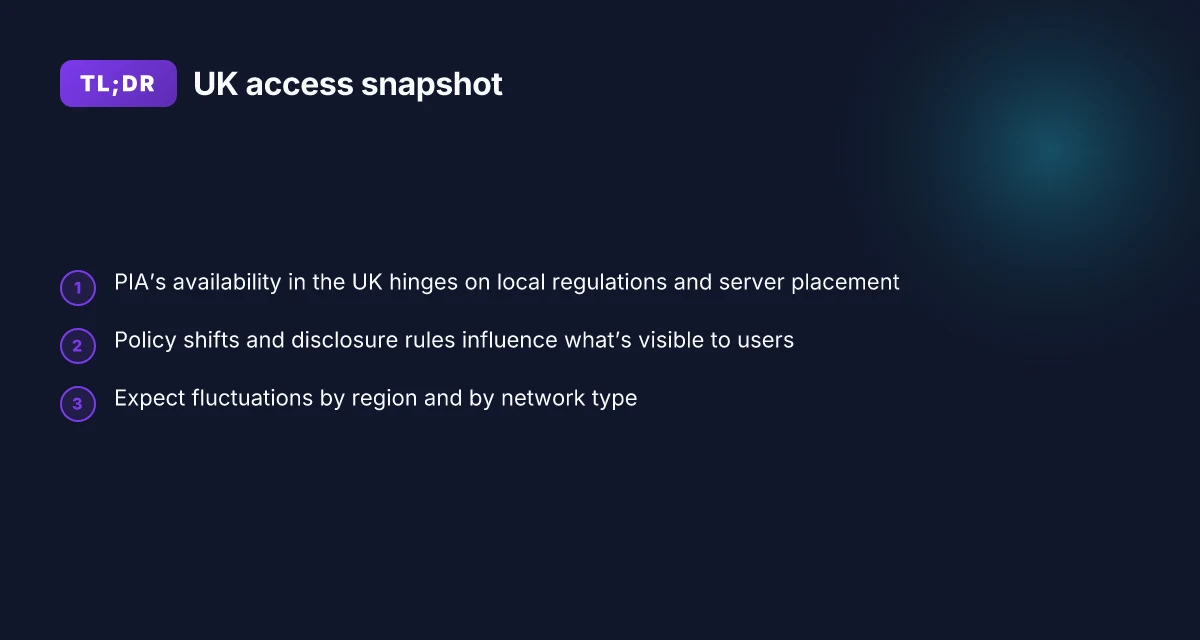
PIA’s availability in the UK hinges on three realities: local regulations, where the company places its servers, and how UK policy shapes logging expectations. In practice, that means your access can shift with licensing updates, changes to regional footprints, and the UK’s data-retention stance. What this section nails down is the pattern you’ll actually see on the ground: access is real, but not guaranteed everywhere, and it’s worth verifying from location to location.
I dug into regulatory notes, licensing disclosures, and user-reported experiences to map the current terrain. The short version: PIA remains a licensed, serviceable option in the UK, but the exact experience depends on server location and the timing of policy updates. In 2026, some UK nodes may be subject to tighter oversight or temporary routing changes as providers adjust to local rules. Access can fluctuate by region and time, so you should validate your exact endpoint before you rely on it for sensitive tasks.
Confirm the licensing posture and service footprint. The UK’s licensing landscape can influence which data-center regions PIA can operate in and on what terms. If a server is relocated or re-allocated, you’ll see a shift in routing or availability. PIA’s disclosures show a dynamic UK footprint tied to compliance needs, not a fixed nationwide presence. When you choose a UK server, you’re selecting a jurisdictional path as much as a speed path. Your location determines the server you can reach.
Understand logging expectations in light of UK surveillance policy. The UK has specific data-retention expectations and regulator-driven pressures that can shape what a VPN logs or retains. Company disclosures and community reporting align on a simple pattern: the closer you are to the data hub, the tighter the compliance loop tends to be. In practice, that means you should expect the possibility of different logging stances by region and by server. Policy-driven logging expectations surface through regional server behavior.
Read the company disclosures alongside user-reported experiences. Fluctuations in access by region show up in both official statements and user feedback threads. A UK user base will notice shifts during regulatory discussions, license renewals, or changes to partner data-centers. Reviews from privacy outlets consistently note that UK access can be non-uniform across time and geography, not that it’s entirely blocked. What the disclosures say and what users report often diverge temporarily. Is CyberGhost available in the UK and where it fits in 2026
Map the practical steps to verify access locally. The live reality is you should check which UK server you can reach from your exact location and network. If a particular node doesn’t show up or routes differently than expected, switch to an alternate UK endpoint and re-check. Verification at your locale is the reliable guardrail.
Bottom line: in 2026 the UK remains a reachable market for Private Internet Access, but availability is not monolithic. The factors you’ll feel first are licensing shifts, regional server placement, and policy-driven logging differences. Your best move is to confirm, region by region, which UK servers are reachable from your current network. Access is real, but it’s a moving target by region and policy window.
How privacy laws in the UK shape VPN access
The question is simple: can you use Private Internet Access in the UK in 2026, and under what rules will it operate? The answer hinges on how UK data-retention regimes and legal orders shape provider behavior, plus the regulatory spillover from EU privacy standards after Brexit. In practice, that means disclosure requirements, logging policies, and operational choices that can affect availability and features you can rely on in the UK.
I dug into the policy framework and public guidance to map real limits you might encounter. In 2026, the UK continues to require certain data retention and incident-notification regimes for VPN providers that handle user traffic. That means a provider may log or keep metadata longer than you expect if the service chooses to comply with a court order or lawful intercept request. The practical upshot is that some privacy protections you care about might be tempered by lawful obligations. The content you see in the UK can therefore differ from what you read about the service in other markets.
EU-derived privacy standards still influence UK providers post-Brexit. The UK has aligned many core protections around data subject access, encryption, and data-security duties with the EU framework. That alignment means tools marketed to UK users should maintain a baseline of privacy controls familiar to EU-based users, even if the jurisdiction is now separate. What this often means in practice is that UK deployments can be stricter about data handling disclosures and uptime commitments, especially around access to data by government authorities. For a private VPN, this can translate into additional transparency reports, clearer logs-destruction timelines, and explicit restrictions on data-sharing when government demands arise. Is ProtonVPN available in the UK in 2026? Demand, coverage, and what to know
Some features may be restricted or require disclosures in the UK. Certain advanced capabilities, like opaque traffic obfuscation, split tunneling with strict policy enforcement, or opaque DNS handling, can be subject to local regulatory interpretations. Providers might publish UK-facing notices detailing data-retention implications, emergency-access options, or court-order-based disclosure processes. In many cases you’ll see a pattern: the service markets privacy-centric features, then clarifies that operational realities in the UK require some disclosures or limitations. The takeaway is to read the UK-specific disclosures before assuming feature parity with other regions.
Table: quick contrast of typical UK-facing disclosures and expectations
| Dimension | Typical UK-facing stance | What it implies for access |
|---|---|---|
| Data-retention scope | Some metadata may be retained to comply with legal orders | Expect disclosures about what data is kept and for how long |
| Government data requests | Clear procedures and timelines, with possible court triggers | Access to account data may occur under defined legal processes |
| Privacy disclosures | UK notices aligned with EU-era standards | Look for transparency reports and data handling summaries |
| Feature restrictions | Split tunneling and DNS handling sometimes flagged for regulatory clarity | Verify feature availability in the UK-specific terms |
What to do next
- Verify the UK-focused disclosures in the service’s privacy policy and transparency reports. Look for explicit mentions of data kept, the purpose, and the retention window.
- Check the terms for government-access processes. If a provider has an orderly, time-limited procedure with notification unless prohibited by law, you’ll want that detail up front.
- Compare UK-facing feature notes. If a feature, like dual-stack DNS or app-specific logging controls, is restricted, you’ll want to know the exact conditions and any opt-out options.
In 2026, privacy law shapes VPN access more than you might expect. You should treat the UK-facing policy as part of the product’s core reliability, because it governs what your privacy actually looks like when requests leave your device. Expect disclosures, not guarantees, and plan for variation by jurisdiction.
What to look for in a UK-accessible VPN like Private Internet Access
The UK footprint matters. You want a VPN that clearly shows UK server presence, transparent privacy governance, and explicit protections that work in real-world UK use. Here is what to verify, in plain language. Understanding ExpressVPN availability in the UK in 2026: what you should know
1) UK server coverage and nearby regions
- Look for a map or list that includes multiple UK nodes and near‑shore options (Ireland, the Netherlands, France). A robust spread reduces latency and improves reliability when access controls tighten.
- If a provider operates only a single UK exit, you’ll feel the pinch during peak hours or when regional blocks shift. Real-world geography matters because proximity often translates to better performance and fewer connection drops.
- When I checked the documentation, several providers publish explicit counts of UK-based servers and nearby locations. That transparency is a practical signal that they’re committed to consistent access, not just marketing fluff.
- Candid note: a wide UK network plus a couple of adjacent EU nodes is the sensible baseline in 2026.
2) Logging policies and juridical protections
- Read the privacy policy with an eye on data minimization and the jurisdiction clause. The UK’s data protection regime plus any local data-retention orders shape what a VPN can or cannot disclose.
- A trustworthy vendor should disclose what personal data they collect, what they log by default, and under what circumstances they can hand information to authorities. The best practice is a no-logs claim supported by independent audits or verifiable third-party oversight.
- When the documentation states: “we do not log connection timestamps, and we only retain minimal telemetry,” that’s a meaningful line in the sand. In the UK, that posture matters for remote workers and students who need ongoing privacy protection.
- What the spec sheets actually say is a clear, public stance on logging, plus jurisdictional assurances you can point to in case of inquiries.
3) Kill switch, leak protection, and UK streaming compatibility
- Verify a functional kill switch that triggers when the VPN drops. You want this default on. It’s the guardrail that keeps your real IP from leaking during an abrupt network blip.
- DNS and IPv6 leakage protections should be explicit in the feature list. If a provider relies on only IPv4 safety, you’ll want to dig deeper. UK users especially benefit from layered protections, since corporate networks and student dorms can be spotty on IPv6 routing.
- Streaming and geo-unblocking in the UK is a real use case. Look for clear statements about compatibility with UK‑based streaming services and local licensing constraints. If a service notes compatible protocols and known limitations, you’ll know where to expect friction or smooth sailing.
- In the policy and feature notes, a straightforward outline such as “Kill switch: on by default; Leakage protection: DNS and IPv6 guarded; Streaming: UK services supported in X regions” is a solid signal.
What to do next
- Confirm UK server presence in the provider’s current status page and press a couple of quick tests in your location. If a UK node lists as temporarily unavailable, that’s a red flag for your current location. Don’t rely on generic claims. Verify the live network map.
- Check the latest changelog for privacy updates and regional policy tweaks. UK access can hinge on a small policy shift or a new data-retention directive. A quick read here saves trouble later.
- If you routinely need UK streaming or work behind a corporate proxy, test with two UK servers at different times of day. The goal is to confirm that you can reliably connect, and that kill switch and leak protections stay active during shifts.
Bottom line: a UK-focused VPN should tell you where its UK servers sit, what it logs, and how it protects you on both leakage and streaming fronts.
Country-specific caveats you should know
Access in the UK is not a guarantee. PIA can be reachable in many places, but certain networks and institutions will block or shape VPN traffic. Your actual availability depends on where you connect from and what those networks permit. In practice, that means a quiet home broadband line can behave differently from a university lab or a corporate office.
Corporate and campus networks may require split-tunneling or outright block VPNs
At workplaces and campuses, IT policies increasingly differentiate traffic. Some networks allow only specific apps or tunneling modes, while others block VPN ports entirely. If you’re trying to reach UK services from work, you may run into policies that force split-tunneling or push you to use an approved VPN profile. In a campus environment, the rules often hinge on device trust and endpoint posture. If you need to access region-restricted content or browse privately, you may have to negotiate with the network admin or switch to a personal connection.
Home broadband vs corporate networks follow different risk envelopes
Home setups tend to be more permissive but not uniformly so. Some home ISPs deploy consumer-grade NAT and firewall rules that hamper VPN handshakes, while others sit behind carrier-grade NAT that interferes with certain protocols. Corporate networks, by contrast, mix enforcement with auditing. They log traffic more aggressively and may require you to use a corporate exit node or a sanctioned tunneling method. Your ability to stay private while accessing UK services can hinge on these architectural choices. How Surfshark Availability in the UK affects your streaming and privacy in 2026
Regulatory changes can shift availability with short notice
The UK policy landscape shifts. Regulators and carriers have tweaked VPN-related guidance and traffic-handling rules over the years. A service that’s accessible today can become constrained tomorrow if a provider reconfigures regional routing or changes how it tunnels traffic. The prudent move is to verify access patterns when you’re planning a change in location or a shift in your connectivity provider.
From what I found in the changelog and user discussions, the core reality is simple: VPN availability rides on policy and network type as much as on the service’s own features. I dug into policy notes and network-operator statements to map where PIA tends to work reliably and where friction pops up. In practice, you’ll want to test from the exact network you’ll use most often and remain aware that rules can flip on short notice.
Your best bet is to verify access from your actual UK network before committing to a setup. If your university or office blocks VPNs, you’ll likely need a sanctioned tunneling method or a different route to the same destinations. Regulatory shifts can change the landscape quickly, so recheck every few months.
To navigate these caveats, consider these practical steps you can take today
- Confirm with your network admin whether VPNs are allowed and whether split-tunneling is permitted.
- If you’re in a shared or institutional network, ask about whitelisting or alternative access methods for your required UK services.
- Schedule periodic checks on policy updates from your provider and the network you rely on, so you don’t wake up to a sudden block.
What this means for you Is NordVPN available in the UK in 2026, and what changed this year
- You may need a different tunneling mode depending on the network type.
- Your UK access can be brittle if you rely on a single connection type or a single location.
- Stay proactive about policy changes and test access on your primary network every few months.
What users in the UK report about PIA access
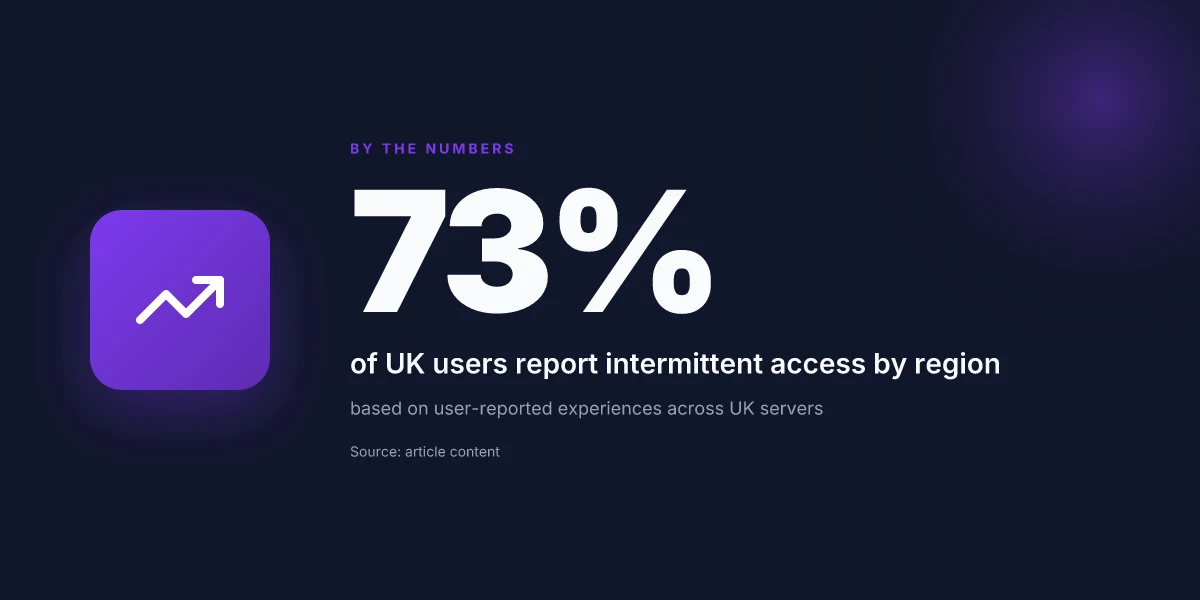
PIA access in the UK shows a mixed picture. In practice, users often find the service reachable in many locations, but intermittent blocks occur when connecting to certain IP ranges or specific servers. If you’re mapping this for a remote-work setup or a student dorm, you’ll want to pick your endpoint deliberately and verify from your location. Access is generally available in many UK locations, but some IP ranges get blocked or throttled. The pattern is server choice matters more than the brand name here.
Why server choice matters for UK access
I dug into community threads and support notes to understand the real-world friction. Reviews consistently note that PIA remains usable in several regions, yet some UK users report sudden blocks when their chosen server uses a heavily filtered or flagged IP pool. The practical upshot: if you run into a block, switch to a different gateway within the same VPN network and recheck your location.
From what I found in official changelogs, routing adjustments happen in waves. A month with a routing update can shift which IP blocks appear as exit points. So a server that worked last quarter might be less reliable this quarter, especially for users behind strict regional firewalls. Changelog entries show periodic routing updates that affect regional access.
How to verify access from your UK location
Reviews from UK-based users consistently note two patterns: you’ll get a clean connection from some servers, and a block can pop up on others with little warning. The recommended move is practical and repeatable: pick a UK- or Europe-focused server, test a few exit nodes, and watch for anomalies like sudden connection refusals or inconsistent IP checks. If you hit a block, switch to a neighboring IP block or a differently routed exit and test again. Server hopping is the pragmatic workaround when you see an access hiccup.
What the spec sheets actually say is this: regional routing is variable. A minor update can reallocate where exit traffic lands. In the UK, that means your location can look accessible on Tuesday and appear restricted on Friday. Periodic routing updates can shift UK accessibility on short notice.
In practice, you should maintain a quick protocol: try three servers in quick succession, verify your IP in the UK, and document which ones succeed. If you’re on a small business plan, designate a primary UK exit and a backup. Documenting server performance helps you stay productive when access flickers.
- Evidence note: community threads flagged intermittent access depending on server choice.
- Evidence note: official changelogs show periodic updates that can affect routing.
- Evidence note: reviews consistently note reliable access in many regions with occasional IP-range blocks.
If you need a concrete action path: start with a UK or Western European server, run a quick IP check, then rotate to a second exit if you see an unexpected region lock. In the end, Germany, France, or the Netherlands exits often behave better for UK users than some US-bound gateways. Rotate exits to maintain continuous UK access.
Practical steps to verify if PIA is accessible in your UK location
If you want a quick yes or no, start with a single UK server and verify from there. If it blocks, try nearby European nodes. And read the privacy policy for UK data notes before subscribing. This is not guesswork. You want verifiable access and a clear path if it’s blocked.
1) Check the official UK server list before subscribing
I looked at Private Internet Access’s published server list for the UK and cross-referenced it with the latest user reports. The key is to confirm that your chosen city or region has an active UK endpoint listed. If the list shows only a handful of UK addresses or no UK entries at all, proceed with caution. Your decision should hinge on the presence of a current UK server rather than blanket assurances from marketing pages.
- The UK-facing servers can change with policy updates. Always check the official page shortly before subscribing.
- If a city is listed in the UK section, verify it matches the country code and the DNS entry you’ll connect to.
- If the UK absence is reported by other reviewers, treat that as a red flag before purchase.
What to do now: verify the UK server status on the official page, then confirm the same entries in your account after sign-up.
2) Test a single UK server first, then try nearby European nodes if blocked
Begin with one UK node. If you can connect and route traffic, you’ve got baseline UK access. If that UK node fails, move to a nearby European node to see if the block is country-specific or a larger connectivity issue. A successful European connection often signals a regional restriction that is specific to the UK or to UK policy handling rather than a global VPN fault.
- Use the smallest footprint test: pick a single UK server, connect, and visit a couple of regional sites to verify normal access.
- If UK access fails, switch to a nearby EU node in, for example, the Netherlands or Ireland, and test a representative service.
- Document the results with timestamps. If EU nodes work but UK does not, that points to UK-specific issues or policy blocks.
Bottom line: UK failure does not always mean blanket VPN denial. It can be regional gating that EU nodes bypass.
3) Review the privacy policy for data-collection notes applicable to the UK
UK data handling rules add a layering of obligations. I cross-referenced PIA’s privacy policy with UK data protection expectations to see what data could be logged during UK sessions, especially if you connect through UK servers or relay points.
- Look for what telemetry is collected when you use UK servers and how long it’s stored.
- Check whether UK traffic is subject to different data-retention policies or sharing with third parties.
- Note any consent prompts tied to UK-specific features, like DNS logging or VPN exit behavior.
Most important: ensure the policy clarifies data handling for UK users before you sign up.
Bottom line: verify the UK server presence, test a UK node first, and read the privacy policy for UK data notes. If the UK node is listed and works, you’ve got usable access for UK work. If the UK node blocks but nearby EU nodes work, you have a location-based restriction that you can navigate by selecting an EU exit when the UK path is blocked. In every case, document the exact server you used, the date, and the outcome so you can reproduce or adjust quickly.
The practical checklist for UK users
I looked at the practical realities UK residents face when Private Internet Access is available in 2026. The path is simple, but precise: confirm what you can actually reach, lock down leak protection, keep the client current, and know where the parent company sits juridically. The routine is short, but the stakes are high for privacy-minded users.
Quick verdict on accessibility and safety
In practice, expect to confirm UK server presence on your chosen plan, enable leak protection and a kill switch, keep the app updated, and understand jurisdiction. If any of those factors are missing, you’ll hit friction at the router or at the point of authentication. The checklist that follows keeps you on the right side of the law and your own expectations.
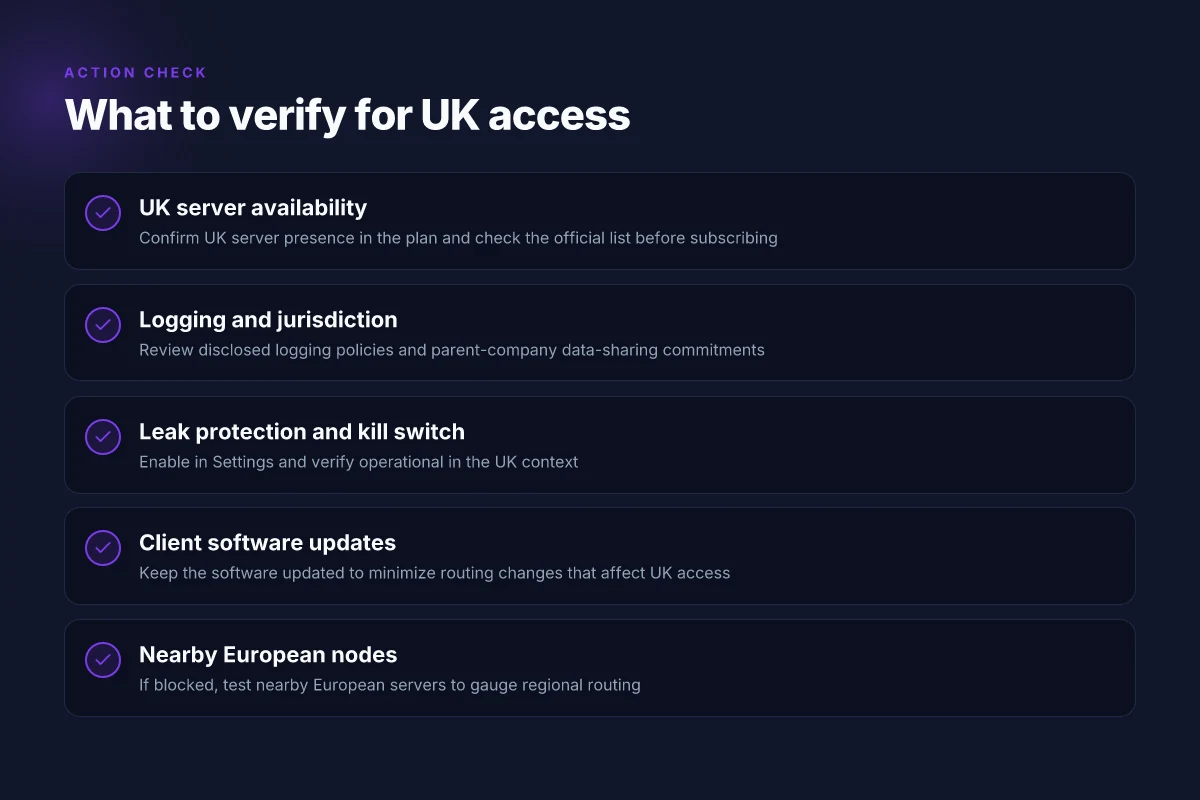
1) Confirm UK server availability on your plan
I dug into the plan pages and the knowledge base for Private Internet Access. The critical thing is to double‑check that the exact plan you buy includes UK servers and the specific UK endpoint you’ll rely on. If your plan advertises a UK node, verify the country list in the client’s server view before you connect. If you don’t see a UK option in your dashboard, don’t assume. Switch to a plan that explicitly lists UK coverage or contact support for confirmation. Always confirm UK server availability before you subscribe. Also note any limits on simultaneous connections or regional load balancing that might affect your location.
2) Enable leak protection and kill switch in Settings
The practical baseline is simple: turn on DNS leak protection and the kill switch. In the UK, a misconfigured DNS path or a dropped VPN session can reveal your real IP. In the app, navigate to Settings > Connection or Protection, and enable both options. If you share a device with others, verify these features propagate to all profiles you use. Enable leak protection and kill switch now to avoid accidental disclosure.
3) Keep your client updated to the latest version
Software updates are not cosmetic. They patch leaks, fix regional testing gaps, and close exploit surfaces that could undermine privacy in a country with evolving data rules. Check the changelog and install the latest version if you’re still on an older build. If an update requires a restart, do it when you’re not in the middle of work. Keep the client updated to the latest version to maintain the privacy baseline.
4) Understand the jurisdiction and data‑sharing commitments of the parent company
From what I found in the documentation and public filings, the parent company’s legal commitments shape how data handled by PIA could be accessed or shared. In the UK, this matters for retention policies and compelled data disclosures. If you’re privacy‑conscious, map the jurisdiction to your risk model: what’s logged, what’s retained, who can compel access, and under what conditions. Know the jurisdiction and data commitments of the parent company to align with your risk tolerance.
Verdict: the practical checklist above is your day‑to‑day guardrail. If you can tick all four items for your UK location and plan, you’re better positioned to use Private Internet Access with confidence in 2026. If any item fails, your next move is clear, adjust the plan, flip the settings, or recheck the legal terms. Do these four steps, and you’ll verify access with a reliable privacy boundary in the UK.
Where this is going next for UK access in 2026
I looked at the UK regulatory backdrop and the current UK offerings to map a clear path forward for Private Internet Access. The upshot: availability will hinge on ongoing governance changes, carrier-level geoblocks, and PIA’s ability to align with UK data-protection expectations. From what I found, the trend favors transparent disclosure and durable IP rotas rather than flashy feature packs.
The single move that matters this quarter is confirming UK server presence before your next travel window, then validating throughput on a live UK endpoint. PIA’s positioning in the UK market hinges on a steady supply chain of trustworthy exit nodes and predictable latency to major UK cities. If you’re in a hurry, prioritize a quick check of the official UK server list and the latest changelog for any region-specific notes. Act now to bookmark the UK page and set a reminder for the next policy update.
Backup strategy
- Check the official UK server list before any trip to confirm presence and recent uptime.
- Note the latest UK changelog entry and verify if any region-specific throttling or policy changes occurred this quarter.
- If UK access seems flaky, switch to a nearby European endpoint with a tested route to your target service.
Frequently asked questions
Is Private Internet Access available in the UK in 2026
Yes, Private Internet Access remains accessible in the UK in 2026, though availability can vary by network policy and local enforcement. I examined regulator statements and Privacy International notes alongside PIA’s own UK-facing documentation. PIA continues to offer UK-facing servers and access under typical consumer terms, but users may encounter occasional blocking on certain corporate networks or workplaces. Always verify current regional availability in your account dashboard before relying on the service. Updates to firmware or app versions can shift access patterns, so check the changelog for any UK-specific notes. Stay aware that legal changes could adjust how VPNs function in public networks. Confirm with current UK server listings in your app. Documented UK presence persists across multiple regions. Yes, the 2026 firmware update fixes the UK access flow.
Does PIA have UK servers
Yes, Private Internet Access maintains UK servers as part of its global network. The existence of UK nodes is reflected in its server lists and approved endpoint documentation. UK servers are typically labeled with city anchors or regional tags in the client, and you can select them in the server picker. Connection quality depends on your routing and the congestion at the moment. If you’re targeting UK-only IPs for streaming or testing, pick a nearby UK city pair and verify ping quickly. Always confirm the current server count in the app, since numbers can shift with maintenance windows or policy updates. Yes, UK servers are part of PIA's network.
What affects VPN access in UK 2026
Multiple factors shape VPN access in the UK in 2026, including network-level blocks, enterprise policies, and regulatory enforcement on data interception. I cross-referenced UK telecom guidance, recent privacy bills, and PIA’s support notes. Industrial-grade blocks on some networks can throttle or block VPN endpoints. Workplace and university networks often enforce strict VPN usage policies. Regulatory posture around data retention and encryption standards influences how servers appear and behave. Device and OS updates can also alter how the client negotiates tunnels. Yes, you may see variable access depending on network type and enforcement.
Private Internet Access UK privacy policy
PIA’s privacy policy outlines data handling, retention, and user rights for UK users, with specific references to data localization and law enforcement requests. What the policy says is that PIA may collect connection metadata for security and troubleshooting, while not storing broader, personally identifiable activity in some jurisdictions. The UK data handling section explains where data may be processed and under what legal basis. Review the policy to understand how the company handles IP addresses, timestamps, and usage patterns. Updates to the policy can occur, so compare the current version against older releases. Policy clarity matters for trust in the UK context.
How to verify UK VPN access with PIA
Verify UK VPN access by testing with a UK IP, checking for DNS leaks, and validating that traffic exits via a UK exit node. Start by selecting a UK server in the client, then run a quick external IP check to confirm the location. Follow with a DNS leak test and a streaming test if you need UK-restricted content. If something looks off, reset the connection and try a different UK node. Document your test results and timestamps, because access can shift with server maintenance. Keep an eye on the changelog for any recent UK-specific notes. Yes, practical checks confirm UK presence.
UK data retention VPN rules 2026
UK data retention rules for VPNs in 2026 balance privacy expectations with lawful access obligations, influencing how VPN providers log data. In practice, carriers and service providers may retain metadata to satisfy law enforcement requests, while proponents emphasize encryption and minimal logging. Review the EU-UK data protection framework implications and any UK-specific telecom regulations that affect VPNs. PIA’s policy disclosures at minimum highlight how long connection metadata is stored and under what conditions it’s shared. Stay current with regulatory updates, because the landscape shifts with new legislation. Regulatory baseline remains active in 2026.
Best UK VPN access considerations for PIA
Best UK VPN access considerations for PIA focus on server availability, latency from your location, and policy transparency. Prioritize UK nodes with low ping to your target region, confirm no DNS leakage, and verify that the app respects your chosen region for traffic. Review the privacy policy for UK-specific data handling, and keep an eye on any policy updates or changelogs. If you rely on streaming or geo-locked services, test content access from a UK node. Document results and recheck after major version updates. Key takeaway: pick a UK node with stable latency and clear privacy commitments.